Short answer. It depends on which way each wall faces, the time of year and what stands to the south of you. With nothing in the way, a south wall in New York can get about 9 hours of direct sun on the shortest day and a north wall none; in June the north wall gets about 7 hours and the south wall less than in March. Neighbors, trees and hills take a share, most of all in winter. To see the real answer for your own house, type the address into a free sun tool that counts the buildings and trees around you, and put a window on each wall.
Try it free: type your address, pick your house, put a window on each wall
The sun's path over a house
In the northern hemisphere, which covers the US, Canada, the UK and Europe:
- The sun rises in the east and sets in the west, but only around March 21 and September 23 does it do so due east and due west.
- In summer it rises in the northeast, climbs high and sets in the northwest. So for a few hours at each end of the day it reaches the north side of the house.
- In winter it rises in the southeast, stays low in the south and sets in the southwest. The north side gets no direct sun at all.
- At solar noon, the sun stands due south. With daylight saving time, that is around 1 pm on the clock, not noon.
How high it climbs depends on how far north you live. The sun's height at solar noon, worked out from each city's latitude:
| City | December 21 | March 21 and September 23 | June 21 |
|---|---|---|---|
| Los Angeles | About 32° | About 56° | About 79° |
| New York | About 26° | About 49° | About 73° |
| Chicago | About 25° | About 48° | About 72° |
| Toronto | About 23° | About 46° | About 70° |
| Vancouver | About 17° | About 41° | About 64° |
| London | About 15° | About 38° | About 62° |
A low sun is easy to block. In December in Vancouver or London, a neighbor's house or a row of trees across the yard can hide the sun all day.
How many hours of sun each side of a house can get
Here are the most hours of direct sun a wall can get in New York, with a flat horizon and nothing in the way. Real numbers are lower once neighbors and trees count.
| Wall faces | December 21 | March 21 | June 21 |
|---|---|---|---|
| South | About 9 h 05 min | About 12 h | About 8 h |
| Southeast or southwest | About 7 h 50 min | About 8 h 15 min | About 8 h 35 min |
| East or west | About 4 h 35 min | About 6 h | About 7 h 30 min |
| Northeast or northwest | About 1 h 15 min | About 3 h 50 min | About 6 h 20 min |
| North | None | None | About 7 h |
Three things surprise most people:
- A south wall gets less sun in June than in March. In June the sun rises and sets well north of east and west, so the south wall only sees it in the middle of the day, when it is high and the light comes in steeply.
- A north wall gets real sun in summer, early in the morning and late in the evening.
- East and west walls get the low sun that comes in almost level. That makes west rooms the warmest on a summer evening.
Farther north, winter days get less sun. In London, a south wall can get at most about 7 h 35 min on December 21, an east or west wall about 3 h 50 min, and a northeast or northwest wall under half an hour. In Toronto the figures sit between New York and London.
What takes the sun from a house
- Buildings to the south. A simple rule: a building blocks the sun whenever the sun is lower than the angle from your window to the top of that building. In New York at solar noon on December 21, with the sun at about 26°, a house 20 ft (6 m) taller than your window and 40 ft (12 m) away is enough to shade it.
- Trees. A tree that drops its leaves lets much more sun through in winter, when it is bare, than in summer. An evergreen lets little through all year.
- Hills. A ridge to the south can end your winter day early.
- Your own house. A porch roof, deep eaves or a wing of the house can shade the windows below or beside it, mostly in summer when the sun is high.
Where does the sun hit my house? A ten-minute check
- Find south. Open your phone's compass at the back door, away from metal, or look at the house on a map. The wall that faces the street is often not the one that matters.
- Name each wall. Front, back and the two sides: which way does each one face?
- Look south from each sunny wall. What stands there, how tall, how far away? Count the stories of the houses and judge the height of the trees.
- Think in winter. Imagine the sun low in the south. If the neighbor's roof or the trees rise above your window's line to it, that wall loses its winter sun.
- Check the hours you are home. Morning sun for a kitchen and bedroom, evening sun for a deck or living room.
This gets you close. It does not tell you the hours, month by month, with the real neighbors. That is what the free tool below is for.
Check the sun on your own house, step by step
Flatwalk's free tool, Sun at your window, works out the hours of direct sun on each window you put on your house, with the buildings, trees and hills around it.
- Type your address under "See the sun at your window". Suggestions come up while you type.
- Find your house on the satellite map. The one under the pin is green; tap another if it is wrong. If your house is missing, tap "It's not on the map, I'll draw it" and draw its outline.
- Tap A whole house ("All floors are mine").
- Put a window on each wall. Every outside wall gets a tag, such as "South wall · sun side" or "East wall". Tap a wall to face it, then tap where the window is, or drag to draw it. You can add up to 8 windows. Each one shows which way it faces, for example "Faces south-west, 224°".
- Tap See my sun. Pick a window, or All, to see the hours of direct sun that day, the first and last sun, and the 12 month bars ("Hours a day, by month").
- Tap Shortest to see the winter, and Longest for June. Drag the hour or play the day to watch the sun move.
- Read "What takes your sun". It names what blocks each window, such as a building to the south or a tree to the east, with the months and hours.
- Turn on Typical weather to see the hours with the usual clouds for each month, not only on a clear day.
If a neighbor's height or a tree looks wrong, tap Something off? to fix a height, add a tree or remove one. Copy link saves the house, the windows and your changes, so you can open the same view later or send it to someone.
A note on solar panels
"How much sun does my house get" is often a solar panel question. This tool measures sun on windows, not on a roof, so it cannot size a solar system. For panels, ask a solar installer for a roof survey.
What it cannot tell you
- Modeled, not measured. The hours are worked out from maps and the sun's position, not from a light meter at your window.
- Where the data is best. Building heights are measured in New York City, Chicago, Toronto, Vancouver and Montreal, and in London, Manchester, Cardiff, Edinburgh, Glasgow, Berlin, Munich, Hamburg, Warsaw, Kraków and Wrocław. Elsewhere heights are estimated, and the tool says so. Outside the areas it covers (in North America: New York State, California, Illinois, Ontario, British Columbia and Quebec) it is slower and treats the ground as flat.
- New buildings and trees. Buildings finished after the map data, and trees planted or cut since about 2017 to 2019, are missing or wrong until you fix them.
- Weather. Typical weather is a monthly average from 2005 to 2023, not a forecast, and can be about 10 to 15% off for a window.
- Windows only. It does not measure a yard, a deck floor or a roof.
- Not a certified report. It cannot stand in for a professional sun study.
- Small things it ignores: window frames, glass tint and your own roof shape. Map outlines can be a meter off the real wall.
Try it free: see the sun on your house, wall by wall
What Flatwalk does that older planners skip
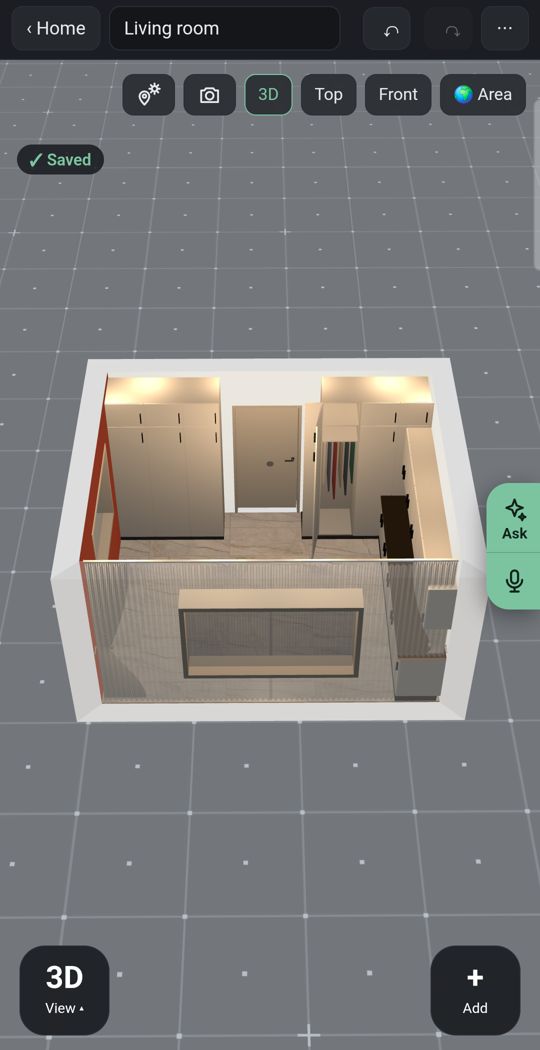
Lights
Add ceiling lights, lamps and LED strips and see where you need them after the sun goes down.
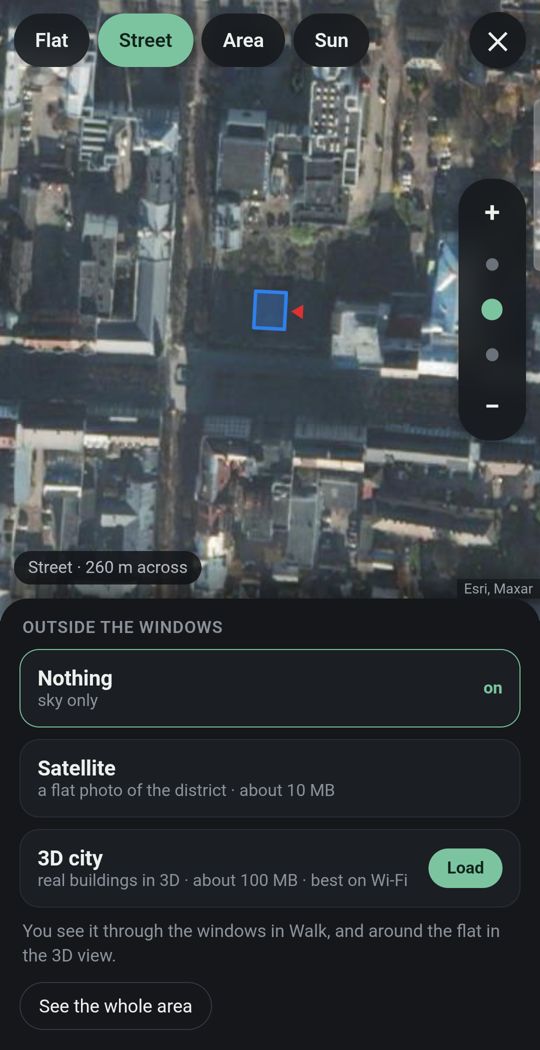
Your home in its city
Enter your address and the street and buildings around you appear in 3D, wherever the map has them.
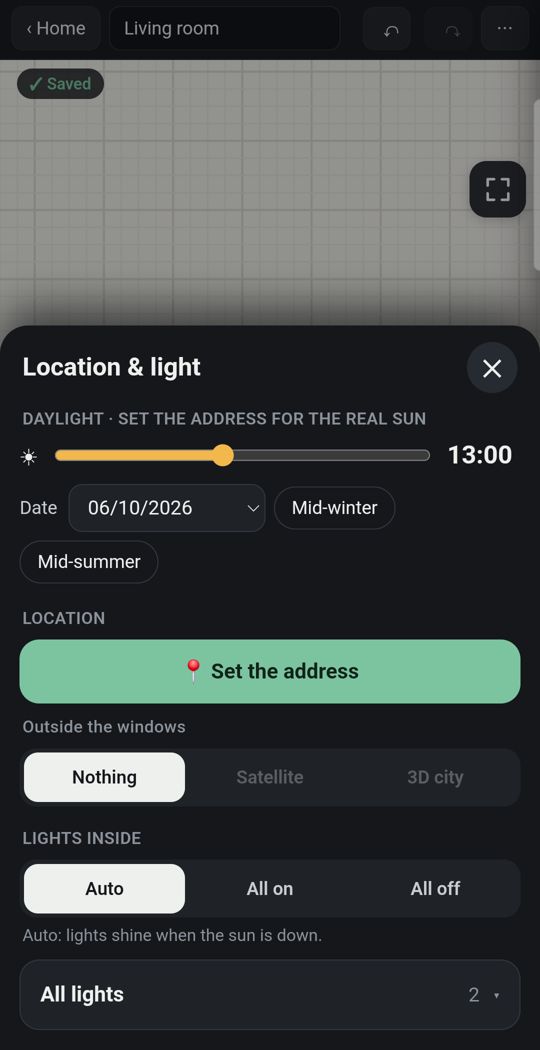
Sun for your address
Real sunlight by date and hour, and how long each room gets direct sun.
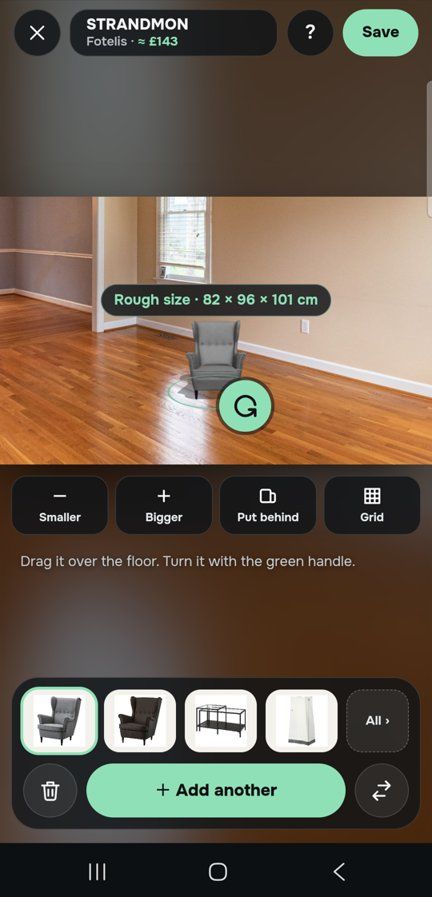
One piece, in your own room
Through the live camera or in a photo of the room, stand a couch on your own floor at its true size.
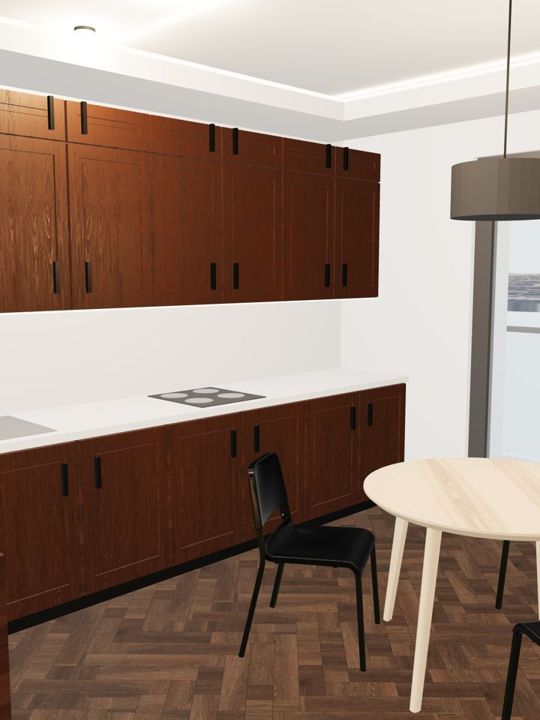
Detail
Window and door types, kitchens, closets and bathrooms built piece by piece.
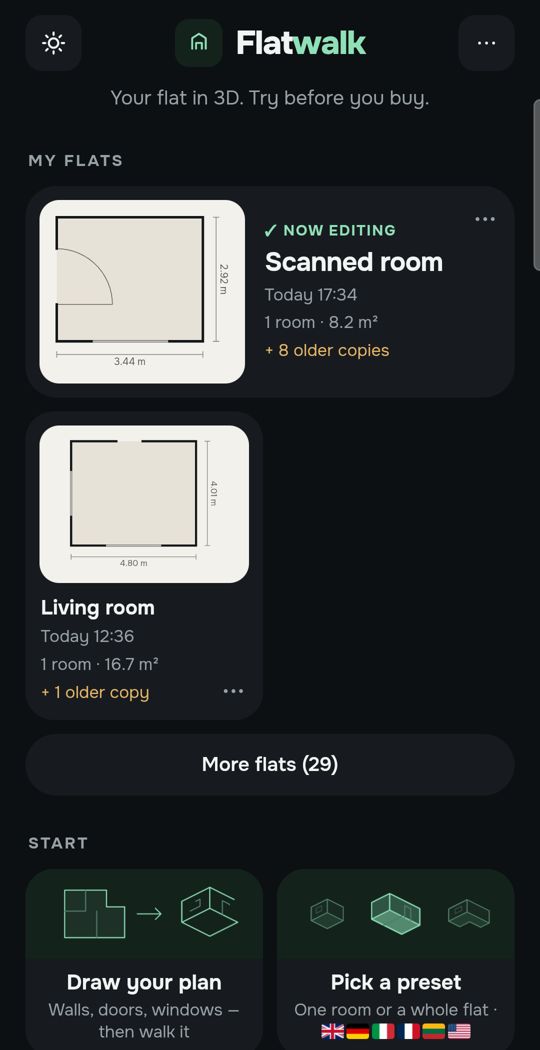
Made for a thumb
Slide the hour with one finger and watch the light move through the rooms.
Swipe for more. Every picture is the app itself.
One home, free
Most people plan one home. For that, Flatwalk costs nothing: no time-limited trial and no card needed. Drawing your home, the sun for its address, lights, furniture and walking through it are all part of it, and each AI tool comes with one free try. A membership is for people who want more homes or more AI.
Questions people ask
How much sun does my house get? It depends on which way each wall faces, the season and what stands to the south. With nothing in the way, a south wall in New York can get about 9 hours of direct sun on the shortest day and a north wall none. A free sun tool that counts the buildings and trees around your address gives the hours for each window, month by month.
How do I find the sun path over my house? In the northern hemisphere the sun rises in the east, stands due south at solar noon and sets in the west; in summer it rises in the northeast and sets in the northwest, in winter in the southeast and southwest. A sun tool shows the arc over your own address on any day.
Which side of the house gets the most sun? The south side, over the whole year. East gets the mornings, west the afternoons and evenings, and north only early and late on summer days.
How can I tell where the sun hits my house? Find south with a compass or a map, name the direction of each wall, and look at what stands to the south of each one. For hours by month, put a window on each wall in a sun tool that counts the neighbors and trees.
Can I check how much sun my house gets for solar panels? Not with a window tool. Sun on a roof needs a solar survey; ask a solar installer.
Flatwalk puts the real sun for your address into a 3D plan of your home, by date and hour, free for one home. It is coming soon to Google Play; join the waiting list at flatwalk.app.
Join the waiting list