Short answer. Birmingham's winter sun is a low one: at midday on 21 December it stands only about 14° up, against about 61° on 21 June. The shortest day lasts 7h 39m, the sun rising at 8:15 GMT in the southeast (129°) and setting at 15:55 GMT in the southwest (231°). The longest lasts 16h 50m, from 4:44 BST, when the sun comes up in the northeast (48°), to 21:34 BST, when it sets in the northwest (312°). So a south window with a clear view has the sun for every daylight minute of December, while a north one never sees it.
See the sun at your own window
Birmingham's sun by month
Each row is worked out for Victoria Square (52.48° N, 1.90° W) on the 15th of the month in 2026, with times on the clock and directions in degrees round from true north (east 90°, south 180°, west 270°). Across the city, from Sutton Coldfield to Selly Oak, the times would shift by about a minute.
| Date | Sunrise | Sunset | Daylight | Sun height at noon | Sunrise direction | Sunset direction |
|---|---|---|---|---|---|---|
| 15 January (GMT) | 8:10 | 16:23 | 8h 13m | 16° | SE, 125° | SW, 235° |
| 15 February (GMT) | 7:23 | 17:20 | 9h 57m | 25° | ESE, 110° | WSW, 250° |
| 15 March (GMT) | 6:22 | 18:11 | 11h 50m | 36° | E, 92° | W, 268° |
| 15 April (BST) | 6:10 | 20:06 | 13h 56m | 47° | ENE, 73° | WNW, 288° |
| 15 May (BST) | 5:11 | 20:57 | 15h 45m | 56° | ENE, 57° | WNW, 304° |
| 15 June (BST) | 4:44 | 21:32 | 16h 48m | 61° | NE, 48° | NW, 312° |
| 15 July (BST) | 5:03 | 21:23 | 16h 20m | 59° | NE, 52° | NW, 308° |
| 15 August (BST) | 5:50 | 20:32 | 14h 43m | 52° | ENE, 65° | WNW, 294° |
| 15 September (BST) | 6:41 | 19:22 | 12h 41m | 40° | E, 84° | W, 276° |
| 15 October (BST) | 7:32 | 18:12 | 10h 40m | 29° | ESE, 103° | WSW, 257° |
| 15 November (GMT) | 7:29 | 16:14 | 8h 45m | 19° | ESE, 120° | WSW, 240° |
| 15 December (GMT) | 8:11 | 15:53 | 7h 42m | 14° | SE, 129° | SW, 231° |
BST runs in the table from the April row to the October row, because the clocks change on 29 March 2026 and 25 October 2026. Over Victoria Square the sun is due south, and at its highest, at 12:05 GMT on 21 December and 13:09 BST on 21 June. Measured above a flat horizon, that highest point is what the "Sun height at noon" column gives.
Birmingham compared with London
Being 1.0° of latitude north of central London and 1.8° of longitude west, Birmingham trades 10 minutes of daylight on 21 December for 11 extra minutes on 21 June. The clock shows the difference too: on the shortest day sunrise comes 12 minutes and sunset 2 minutes later than in London, and on the longest, sunrise 1 minute and sunset 13 minutes later. Noon on the shortest day finds the sun at 14.1° here and 15.1° in London, 1.0° lower. Behind all of it sit two simple rules: the further north, the shorter the winter day and the longer the summer one; the further west, the later the sun rises and sets by the clock, at about 4 minutes a degree.
Hours of sun on each side of a flat in Birmingham
No Birmingham window can beat the figures below: they are the hours of direct sun for each facing on a dead-flat horizon with nothing in front, an open-sky upper limit. Every building, tree and balcony above you takes some away, and in winter, with the sun low, they take the most.
| Window faces | 21 December | 21 March | 21 June |
|---|---|---|---|
| North | None | 15 min | 7 h 25 min |
| North-east | 30 min | 3 h 35 min | 6 h 40 min |
| East | 3 h 50 min | 6 h 05 min | 8 h 25 min |
| South-east | 7 h 10 min | 8 h 40 min | 10 h 10 min |
| South | 7 h 40 min | 12 h | 9 h 25 min |
| South-west | 7 h 10 min | 8 h 40 min | 10 h 10 min |
| West | 3 h 50 min | 6 h 10 min | 8 h 25 min |
| North-west | 30 min | 3 h 35 min | 6 h 40 min |
How to read it:
- December rewards a southern outlook. Of the directions in the table, only those in the southern half of the compass get what feels like a day of sun in December: south has all 7 h 40 min, east and west about 3 h 50 min, and north nothing.
- June tips the balance to the corners. Because the June sun rises and sets well round to the north, a south-east or south-west window (10 h 10 min) beats a south one (9 h 25 min), and even north gets 7 h 25 min, all of it early in the morning or late in the evening.
- The equinox squares things up. In March the compass evens out: by 21 March sunrise lines up roughly with due east and sunset with due west, and a north window gets a mere 15 min.
Treat the table as the best case; the sun tool then takes off, building by building, whatever your own street blocks.
What it means for flats in Birmingham
- South-east to south-west for winter. Flat-hunting in Birmingham with winter sun in mind? Look for main rooms or a balcony facing between south-east and south-west; east then means morning sun, west evening sun, and north steady light with direct sun only early and late on summer days.
- Height above the street. Picture a street 20 m (66 ft) wide from wall to wall, with a five-storey block 15 m (49 ft) tall along its south side and your flat facing it. With the noon sun about 14° up on 21 December, its shadow runs about 60 m (196 ft), 3.0 times the street's width, and the facade facing it is in midday shade up to about 10.0 m: storeys 1 to 3 (counting the ground floor as storey 1, at 3 m a storey) miss the midday sun on the shortest day, and storey 4 is the lowest to catch it. Things change fast after midwinter: by 21 March that shadow is down to about 19 m, less than the street is wide, so the midday sun reaches every floor.
- Canals, workshops and suburbs. In the centre, many flats sit beside the canals in converted warehouses, where the water often runs below street level between tall brick walls. Low windows there can lose the winter sun even with a south outlook, because the wall across the water plays the part of the block in the example. In the Jewellery Quarter, many flats are former workshops on streets much narrower than 20 m, so the shade climbs higher up the facade opposite. Out in the suburbs of Victorian terraces and interwar semis the houses are low, which leaves upper windows and gardens a far wider sky.
- Upstairs balconies. A balcony over a south window shades it more in summer, when the sun climbs to about 61° and comes in steeply, than in winter, when the 14° sun slides in beneath it; on a west balcony the June sun stays until sunset, after 21:00.
- Your garden and your own roof line. At noon on 21 December a house 6 m to the eaves casts a shadow about 24 m long, and it falls to the north, so it is the gardens behind north facing backs that sit in it, while a south facing garden is shaded only by the homes, fences and trees to its south. The June shadow of the same house is about 3 m, hardly any.
Check your own window in Birmingham in 3 steps
For a canal-side flat or a suburban terrace alike, the answer comes from Sun at your window, Flatwalk's free tool, which counts the hours of direct sun on that actual window with the buildings, trees and ground around it. Heights are the weak point here: Birmingham is not yet one of the measured-height cities (London, Manchester, Cardiff, Edinburgh and Glasgow), so the tool estimates them from the building outlines on the map and tells you so plainly. Where a warehouse across the canal or the block opposite looks too tall or too short, put it right with Something off?, and add any large trees the map has missed.
- Start from the map. The search box sits under "See the sun at your window": type your address there, pick out your building on the satellite map and mark it as A whole house or A flat, adding Your floor for a flat.
- Draw in the glass. Tap the wall your window is in (each outside wall wears a tag, such as "South wall · sun side"), then tap the window's spot or drag to draw its outline.
- Read the answer. See my sun gives you the hours of direct sun, the 12 month bars and "What takes your sun"; choose Shortest day for the December test, and Typical weather if you want the usual cloud folded in.
What it cannot tell you
- Sums, not sensors. Everything is calculated from maps and the position of the sun; at no point does a light meter sit at your window.
- Heights in Birmingham are approximate. Birmingham is not among London, Manchester, Cardiff, Edinburgh and Glasgow, the cities with measured heights, so its heights are map estimates: check the ones that matter most to you.
- Newer than the map data. A block finished after the map data was made, or a tree planted or felled since about 2017 to 2019, may be wrong or missing; Something off? lets you alter a height or add the building or tree yourself.
- Clouds as an average. Switch on Typical weather and you get the cloud of an average month across 2005 to 2023; real weather at a single window can differ by about 10 to 15%, and none of it is a forecast.
- Windows are its whole job. Thinking about solar panels on the roof, or whether the lawn or a terrace floor will get sun? Those it does not measure.
- Not evidence for a dispute. Nothing it produces is a certified report or a right to light survey.
- Too fine for the model: the shape of your own roof, the window frames and any tint in the glass. On top of that, map outlines can sit a metre away from the real wall.
Try it free: your Birmingham address, your floor, your window
What Flatwalk does that older planners skip
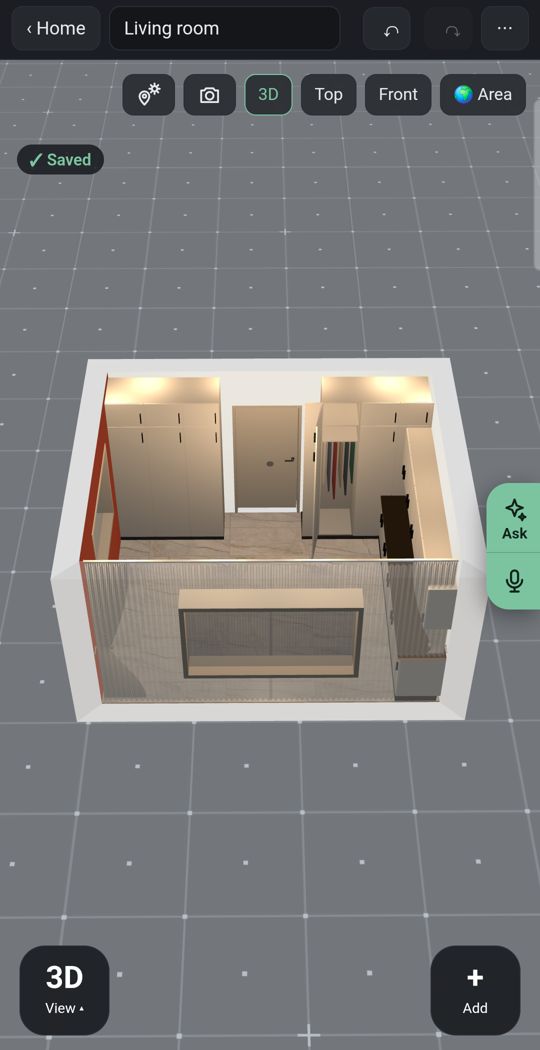
Light after dark
With the December sun gone by about 15:55, Birmingham evenings are long: place ceiling lights, lamps and LED strips and see which corners still need light.
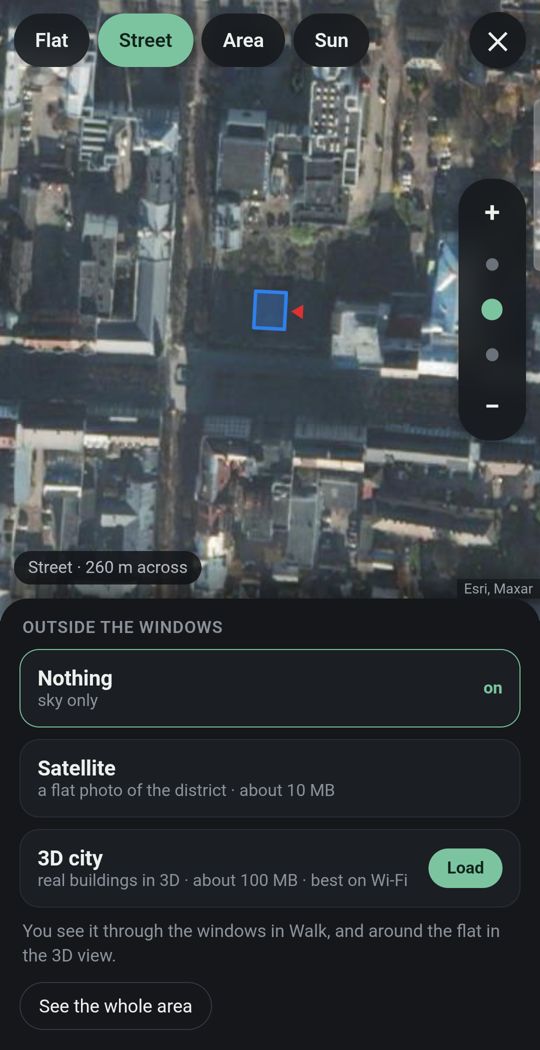
The streets around you, in 3D
Type in a Jewellery Quarter or a suburban address and the neighbouring buildings and street go up in 3D around your flat, wherever the map has them.
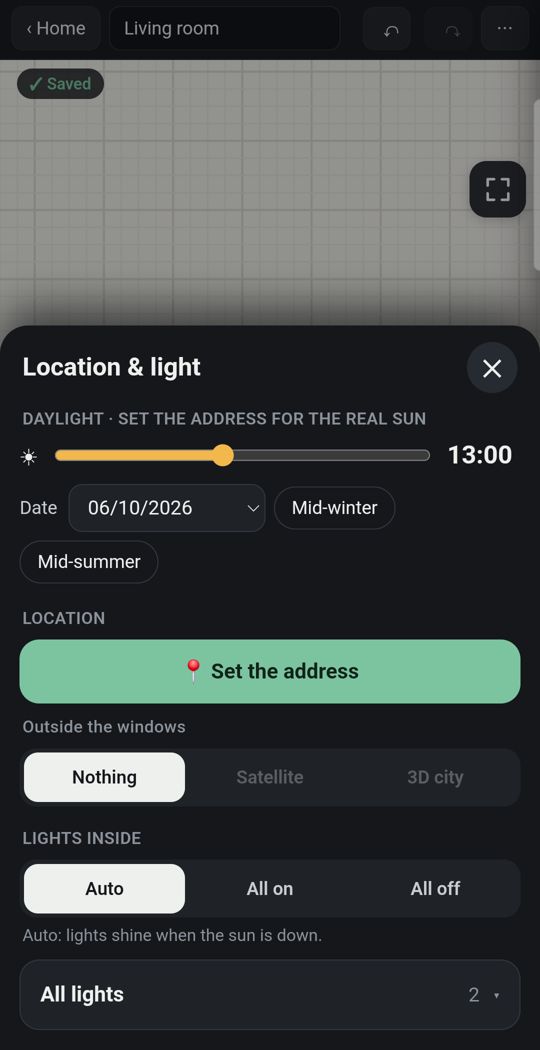
Sunlight where you actually live
The sun is worked out for your own address, hour by hour on any date, and every room gets a count of its hours of direct sun.
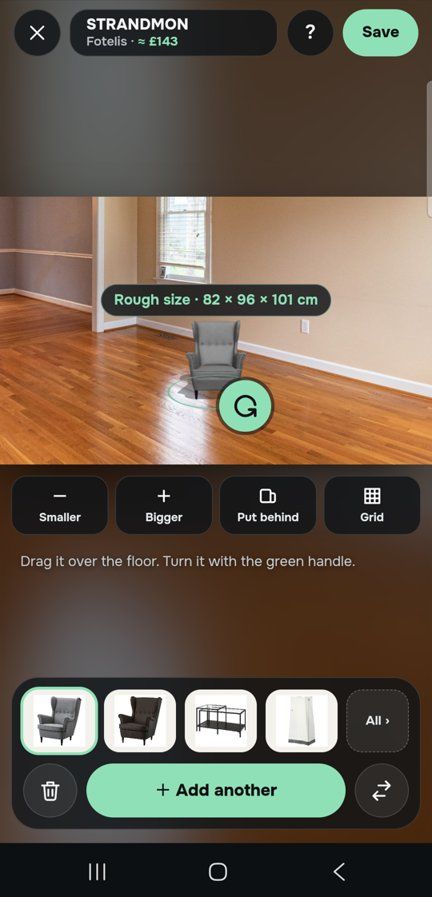
Try the sofa first
Point the live camera at the room, or use a photo of it, and stand one piece there at its true size.
Fitted out properly
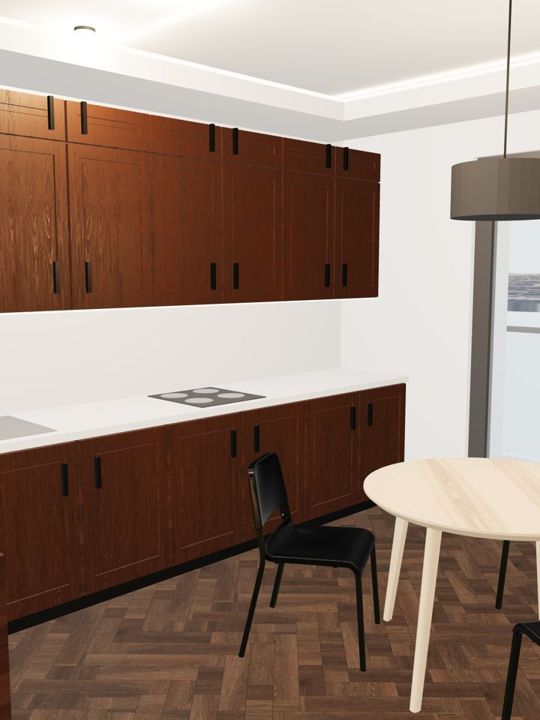
Like a builder working through a Victorian terrace, you choose each window and door type and fit kitchens, wardrobes and bathrooms piece by piece.
One thumb does it
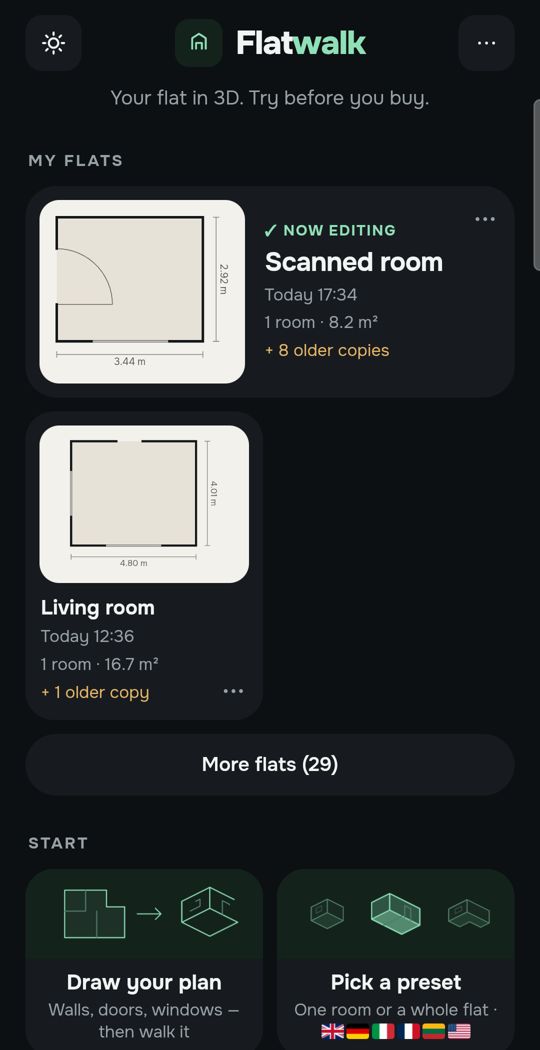
On the phone a single finger drags the hour, and the patch of sun slides across each room as you go.
Swipe for more. Every picture is the app itself.
One flat, free
Planning just one home in Birmingham costs nothing on Flatwalk: no trial clock and no card. You can draw it, check its sun, light it, furnish it and walk through it, and each AI tool gives you one free try; pay for membership only if you want more flats or more AI.
Questions people ask
What is the sun path in Birmingham? Sunrise moves from the southeast in winter to the northeast in summer, and sunset from the southwest to the northwest, passing close to due east and due west around 21 March and 23 September. The height changes as much as the direction: the sun is about 14° up at midday on 21 December and about 61° on 21 June.
What time is sunrise and sunset in Birmingham in December? Birmingham's 21 December 2026 runs from an 8:15 sunrise to a 15:55 sunset, GMT, which is 7h 39m of daylight and not a minute more. Oddly, it is mid-December that has the earliest sunsets (about 15:53), while the latest sunrises wait for the end of the month (about 8:18).
Where does the sun rise and set in Birmingham? On the shortest day the sun appears at about 129° in the southeast and disappears at about 231° in the southwest, whereas on the longest day it comes up at about 48° in the northeast and goes down at about 312° in the northwest.
Which way should my flat face in Birmingham? Main windows between south-east and south-west get the most sun across the year, above all in winter; west suits evenings at home, east early starts. Then, before signing anything, stand at the window and look across the road, because a five-storey block on the far side of a 20 m street leaves the lower three floors with no midday sun on the shortest day. Beside a canal or on a narrow Jewellery Quarter street, the wall opposite may stand closer still.
How high is the sun in Birmingham in winter? About 14° at midday on 21 December is all it manages, and even the best day between mid-November and mid-January brings it no higher than about 19°. In practice, look out from your seat: if the roofline opposite sits more than 14° above your window, the midday sun stays behind it.
Flatwalk puts the real sun for your address into a 3D plan of your flat, by date and hour, free for one flat. It is coming soon to Google Play; join the waiting list at flatwalk.app.
Join the waiting list