Short answer. On 21 December Brighton's midday sun hangs about 16° above the sea, and on 21 June it is about 63° up. Midwinter daylight lasts 7h 57m, from sunrise at 8:00 to sunset at 15:56 GMT; midsummer daylight lasts 16h 31m, from 4:46 to 21:17 BST. The rising and setting points travel a long way through the year: from the southeast (128°) and southwest (232°) in winter to the northeast (50°) and northwest (310°) in June. Facing open sky, as a sea-view window often does, a south facing window can be sunlit for the whole December day, while a north facing one gets none.
See the sun at your own window
Brighton's sun by month
The figures are clock times for central Brighton (50.82° N, 0.14° W), on the 15th of every month in 2026. A direction is a compass bearing from true north: 90° east, 180° south, which here means straight out to sea, and 270° west. Walk from Hove to Kemptown and you gain or lose about a minute.
| Date | Sunrise | Sunset | Daylight | Sun height at noon | Sunrise direction | Sunset direction |
|---|---|---|---|---|---|---|
| 15 January (GMT) | 7:56 | 16:23 | 8h 27m | 18° | ESE, 124° | WSW, 237° |
| 15 February (GMT) | 7:12 | 17:17 | 10h 04m | 27° | ESE, 109° | WSW, 251° |
| 15 March (GMT) | 6:14 | 18:05 | 11h 51m | 37° | E, 92° | W, 268° |
| 15 April (BST) | 6:06 | 19:55 | 13h 50m | 49° | ENE, 73° | WNW, 287° |
| 15 May (BST) | 5:11 | 20:43 | 15h 32m | 58° | ENE, 58° | WNW, 302° |
| 15 June (BST) | 4:46 | 21:15 | 16h 29m | 62° | NE, 50° | NW, 310° |
| 15 July (BST) | 5:04 | 21:08 | 16h 04m | 61° | NE, 53° | NW, 307° |
| 15 August (BST) | 5:47 | 20:21 | 14h 33m | 53° | ENE, 66° | WNW, 293° |
| 15 September (BST) | 6:35 | 19:14 | 12h 39m | 42° | E, 84° | W, 275° |
| 15 October (BST) | 7:23 | 18:08 | 10h 45m | 31° | ESE, 103° | WSW, 257° |
| 15 November (GMT) | 7:15 | 16:13 | 8h 58m | 21° | ESE, 119° | WSW, 241° |
| 15 December (GMT) | 7:56 | 15:54 | 7h 59m | 16° | SE, 127° | SW, 233° |
From 29 March 2026 until 25 October 2026 the clocks are on British Summer Time, hence BST in the April to October rows. The sun stands due south over the Channel, at its highest, at 11:58 GMT on 21 December and 13:02 BST on 21 June, and that top point above a flat horizon is what the noon column shows.
Brighton compared with London
Being 0.7° of latitude south of central London is enough to show in Brighton's light. The coast gains 7 minutes of daylight on London on 21 December and loses 8 minutes on 21 June. The clock differences are small: 3 minutes earlier for a winter sunrise and 3 minutes later for a winter sunset, then in June a sunrise 3 minutes later and a sunset 4 minutes earlier. That shows in the noon sun too, which on the shortest day stands 0.7° higher here than in London: 15.8° against 15.1°. The general rule, that further south means longer winter days and shorter summer ones, hands Brighton a little winter light that London misses.
Hours of sun on each side of a flat in Brighton
Here is the most direct sun a window could get for each way it faces, on a flat horizon with nothing in the way: an upper limit for open sky. Looking out to sea, that flat horizon is close to the truth; inland, buildings, trees and the balcony above all take a share, and they take most in winter, when the sun is low.
| Window faces | 21 December | 21 March | 21 June |
|---|---|---|---|
| North | None | 15 min | 7 h 15 min |
| North-east | 35 min | 3 h 35 min | 6 h 35 min |
| East | 4 h | 6 h 05 min | 8 h 15 min |
| South-east | 7 h 20 min | 8 h 35 min | 9 h 55 min |
| South | 7 h 55 min | 12 h | 9 h 15 min |
| South-west | 7 h 20 min | 8 h 40 min | 9 h 55 min |
| West | 4 h | 6 h 10 min | 8 h 15 min |
| North-west | 35 min | 3 h 35 min | 6 h 35 min |
What Brighton's figures tell a flat hunter:
- Midwinter: the seaward side wins. A south window, the one that usually looks at the sea, is in sun for every minute of daylight (7 h 55 min); turn to east or west and it is about 4 hours each, while north gets none.
- Midsummer: south-east and south-west lead. Their 9 h 55 min beats the 9 h 15 min facing south, because the June sun comes up and goes down far round to the north, and a north window still gets 7 h 15 min, early in the morning and late in the evening.
- Equinox: in from the east, out to the west. When the sun comes up close to due east and goes down close to due west, as it does around 21 March, a north wall sees it for just 15 min.
Nothing in Brighton beats these numbers; the sun tool then takes off whatever your street blocks, one building after another.
What it means for flats in Brighton
Brighton looks south. The sea lies to the south of the city, so a flat with a sea view usually faces the winter sun, with a truly flat horizon across the water. Many of the Regency terraces and squares along the front have bow windows, which bulge out from the wall and can catch sun from more than one direction. Behind the seafront the streets climb north, so much of the town sits on a slope that tilts towards the sun, while lower ground floor flats below the pavement, and the narrow streets of the North Laine, struggle to see a sun only about 16° high in December.
- Which side. For winter sun the main rooms or a balcony should face somewhere between south-east and south-west, which on the seafront usually means the sea. West brings the evening, east the morning; north has even light and direct sun only early and late in summer.
- Which storey. Brighton mixes low terraces with some taller blocks, so the five-storey case is worth knowing. A block 15 m (49 ft) high, under a noon sun about 16° up on 21 December, casts a shadow about 53 m (174 ft) long, 2.7 times the width of a 20 m (66 ft) street, wall to wall, and the facade facing it is shaded at midday up to about 9.3 m. Up to storey 3, with the ground floor as storey 1 and 3 m to a storey, there is no midday sun on the shortest day; from storey 4 up there is. The same block's shadow on 21 March is about 18 m, less than the width of the street, so every floor has sun at noon.
- Shade from above. A balcony overhead shades a south window more in summer, when the sun at about 63° falls steeply, than in winter, when the 16° sun gets in under it. A west balcony, catching the sun as it goes down towards Hove, holds it until sunset, after 21:00 in June.
- Yards and gardens. On 21 December the noon shadow of a house 6 m to the eaves stretches about 21 m, straight to the north. Behind a house that faces the sea, the back yard lies on that north side and can stay in shade through midwinter; a yard on the south side keeps its sun unless the next row of houses blocks it. By the June solstice the noon shadow of the same house is about 3 m, so most of the yard behind gets its sun back.
Check your own window in Brighton in 3 steps
Whether your window looks at the sea or at the house across a twitten, Sun at your window, a free Flatwalk tool, counts its hours of direct sun with the buildings, trees and ground around it in the model. Brighton's building outlines come from the map, but the city is not yet among those with measured heights (London, Manchester, Cardiff, Edinburgh and Glasgow), so heights are estimated and the tool tells you so. A building opposite at the wrong height can be put right with Something off?, which also lets you plant any big trees the map has left out.
- Find your home. Under "See the sun at your window", search your address and find your roof on the satellite map; A whole house or A flat comes next, and a flat also needs Your floor.
- Draw the windows. On a seafront house the front wall may well carry the tag "South wall · sun side". Tap the wall, then the place the window is, or drag to draw it.
- Check the sun. For the December test, open See my sun with Shortest day selected, and the screen fills with the hours of direct sun, the 12 month bars and "What takes your sun". With Typical weather on, the hours allow for the cloud a usual month brings.
What it cannot tell you
- An estimate from maps. Map data and the sun's position produce the hours; no light meter is ever held at your window.
- Heights not yet measured here. As the tool section says, the seafront and the streets behind it are modelled with estimated heights, so look again at the buildings that matter to you.
- Changes along the street. Since about 2017 to 2019 trees have been planted and cut, and some buildings have gone up after the map data was made; until Something off? is used to change a height or add the building or tree, those stay wrong or missing.
- Average skies. Sea mist or sunshine on the day means nothing to Typical weather: it is a monthly average for 2005 to 2023, not a forecast, and may be about 10 to 15% off for any one window.
- Windows, not lawns or roofs. Sun on a lawn, on a terrace floor or on a roof you want to put solar panels on is not something it works out; it deals in windows.
- Not for lawyers. It has no standing in a solicitor's office, being neither a legal or certified report nor a right to light survey.
- Ignored detail. Frames and tinted glass are not in the model, nor is the shape of your own roof; and since it trusts the map, an outline may sit a metre off the real wall.
Try it free: your Brighton address, your floor, your window
What Flatwalk does that older planners skip
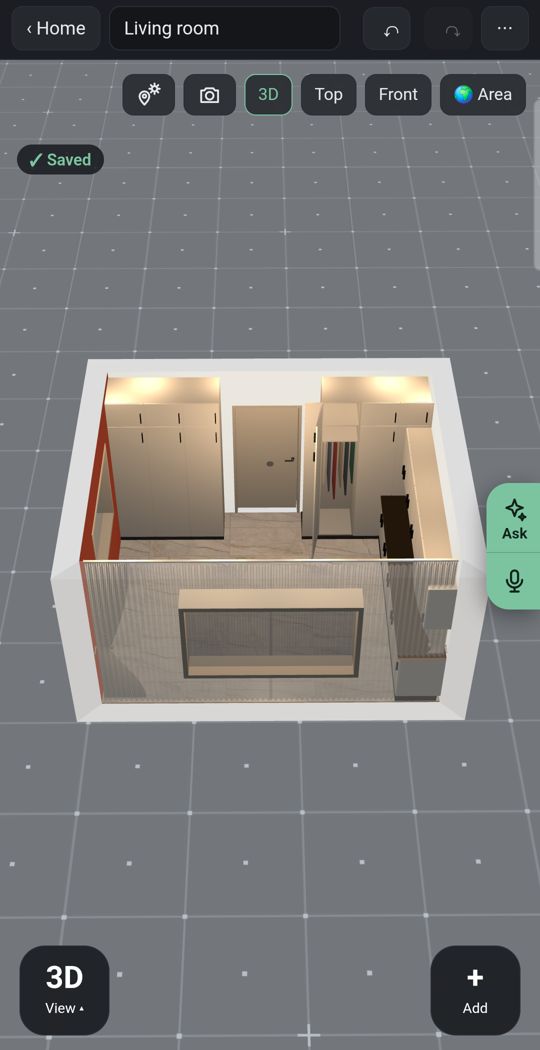
Light for the evenings
Plan the dark hours too, with ceiling lights, lamps and LED strips placed wherever the flat still needs them after sunset.
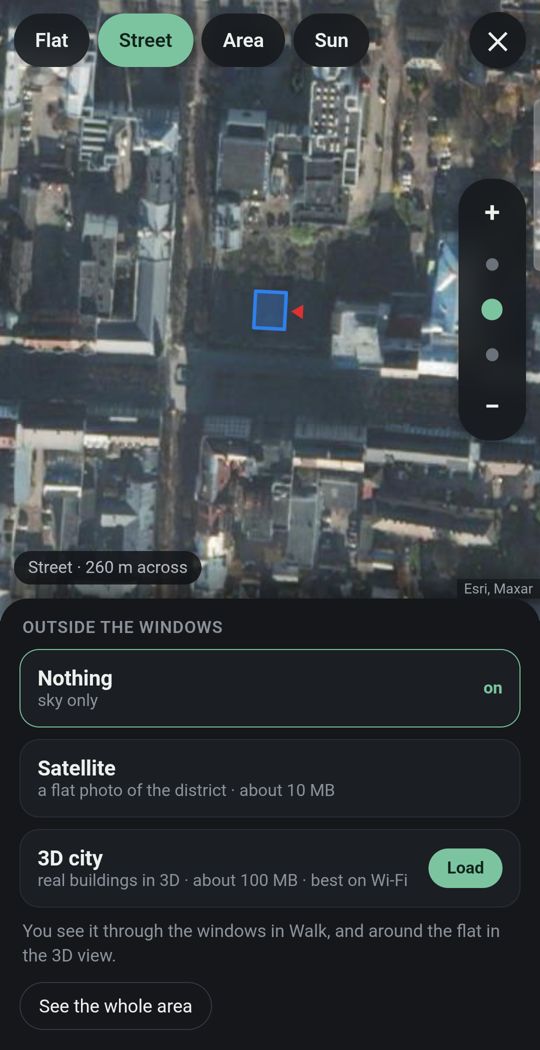
Your flat, your neighbourhood
Type an address and the neighbourhood is rebuilt in 3D around your flat, as far as the map reaches.
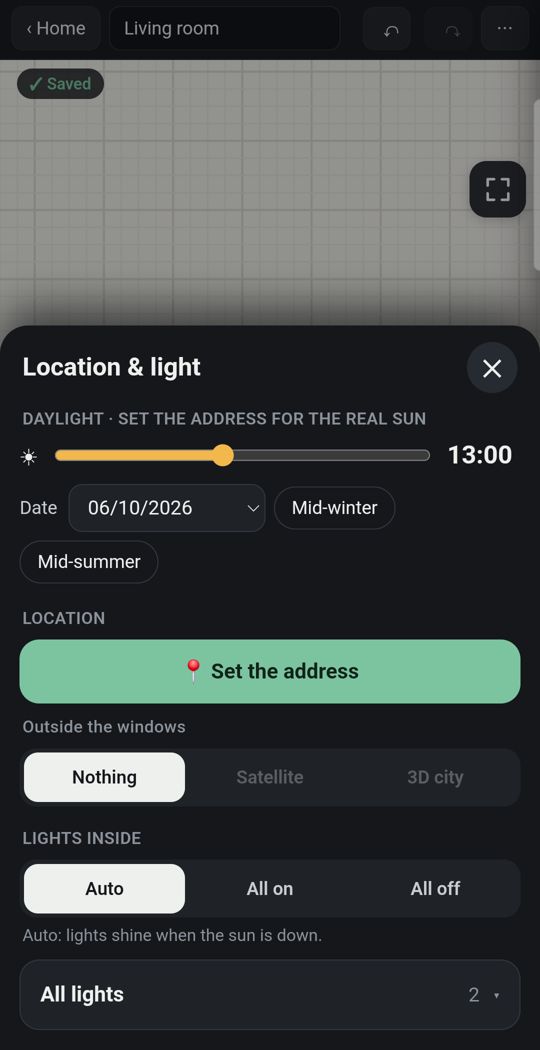
Sun at the address
Sunlight is worked out for your own address: set the date and hour, and each room shows how long it is in direct sun.
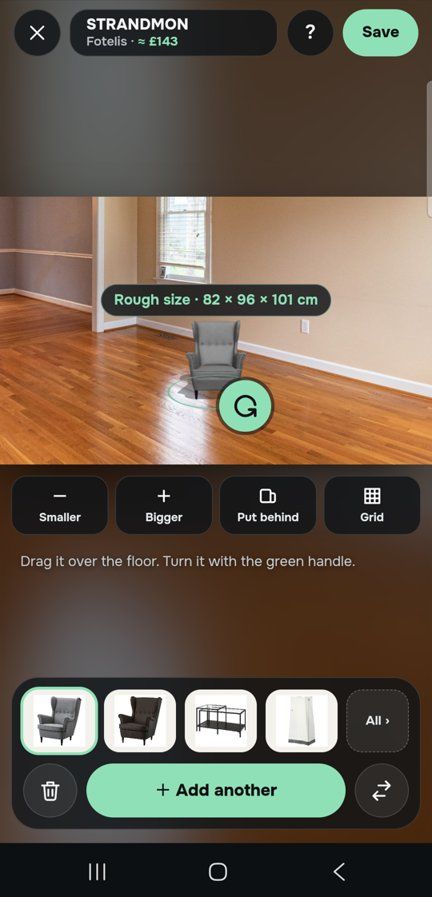
Try before the removal van
A corner of your real room, seen through the live camera or in a photo, can hold a sofa on your own floor at its true size.
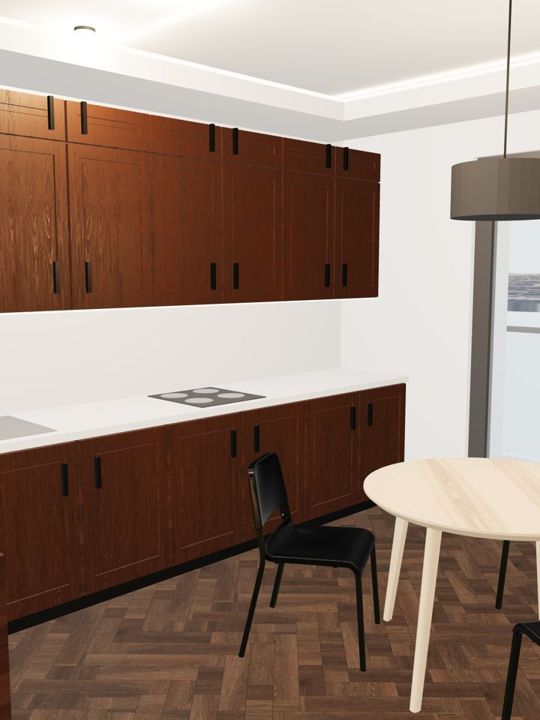
Doors, windows, kitchens
Pick from window and door types, fit a kitchen, a wardrobe or a bathroom, and the flat takes shape piece by piece.
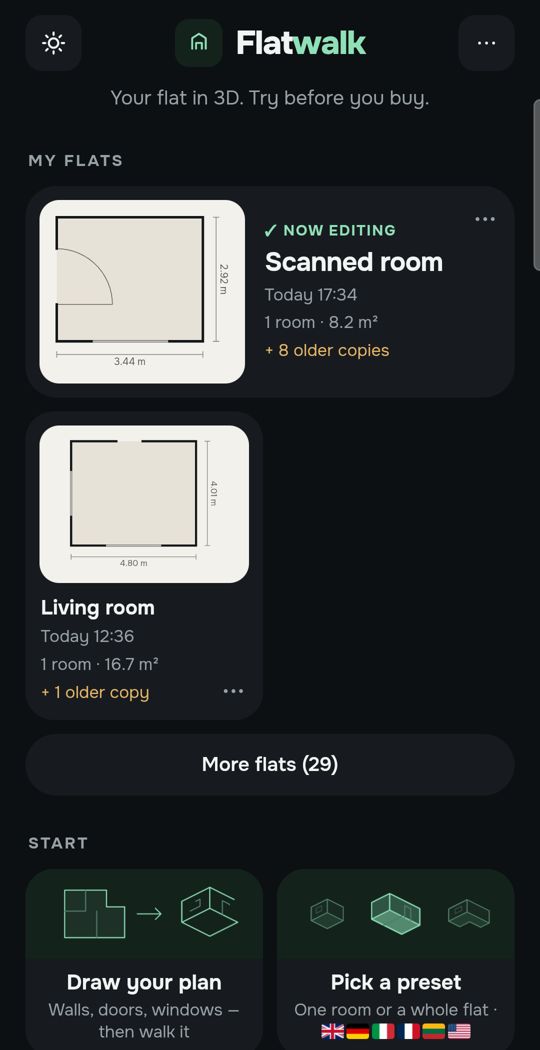
Works one-handed
Run a finger along the hour and the light sweeps across the rooms, morning to evening.
Swipe for more. Every picture is the app itself.
One flat, free
One home to plan? Flatwalk costs you nothing for it: no card, no trial ticking away. Everything is in: you draw it, see the sun at its address, furnish and light it, walk through it, and have one free go at every AI tool. The paid membership is there for extra flats and extra AI, and for nothing else.
Questions people ask
What is the sun path in Brighton? In winter the sun rises in the southeast, travels low across the southern sky over the sea, at about 16° at midday on 21 December, and sets in the southwest. By 21 June the arc has swung inland: up in the northeast, as high as about 63° at midday, and down in the northwest. Around 21 March and 23 September it rises and sets roughly along the line of the coast, close to due east and due west.
What time is sunrise and sunset in Brighton in December? Brighton's 21 December 2026 gives 7h 57m of daylight, starting at 8:00 and ending at 15:56 GMT. Sunsets bottom out in mid-December at about 15:54, but sunrises go on getting later until the end of the month, about 8:02.
Where does the sun rise and set in Brighton? In midwinter both ends of the arc sit on the seaward side of the compass, with sunrise at about 128° (southeast) and sunset at about 232° (southwest). Midsummer swings both ends round to the landward side of the town: about 50° (northeast) at dawn and about 310° (northwest) at dusk.
Which way should my flat face in Brighton? For the most sun over a year, and above all in winter, which in Brighton often means a sea view, face somewhere between south-east and south-west. West suits evenings at home, east suits early starts. The street matters as much as the compass, though: on the shortest day a five-storey block over a 20 m street shuts the lowest three floors out of the midday sun.
How high is the sun in Brighton in winter? Only about 16° at midday on 21 December, low enough to reach deep into a south facing room, and no midday between mid-November and mid-January sees it above about 21°. Sit at your window and look across: anything rising more than 16° above it will hide that midday sun.
Flatwalk puts the real sun for your address into a 3D plan of your flat, by date and hour, free for one flat. It is coming soon to Google Play; join the waiting list at flatwalk.app.
Join the waiting list