Short answer. Cardiff gets 7h 50m of daylight on 21 December, from 8:15 to 16:05 GMT, and 16h 38m on 21 June, from 4:55 to 21:33 BST. The midday sun reaches about 15° on the first date and about 62° on the second. Its rising point moves from the southeast (128°) in December to the northeast (49°) in June, and its setting point from the southwest (232°) to the northwest (311°). Facing the Bay or any other clear view south, a window can keep the sun all through a December day; a north facing one gets no direct sun.
See the sun at your own window
Cardiff's sun by month
Cardiff's figures are worked out for the city centre (51.48° N, 3.18° W) on the 15th of each month in 2026, and the times are clock times; between Roath and Canton they would shift by about a minute. East is 90° on this scale, south 180° and west 270°, all counted from true north.
| Date | Sunrise | Sunset | Daylight | Sun height at noon | Sunrise direction | Sunset direction |
|---|---|---|---|---|---|---|
| 15 January (GMT) | 8:11 | 16:33 | 8h 22m | 18° | SE, 124° | SW, 236° |
| 15 February (GMT) | 7:26 | 17:27 | 10h 01m | 26° | ESE, 109° | WSW, 251° |
| 15 March (GMT) | 6:26 | 18:17 | 11h 50m | 36° | E, 92° | W, 268° |
| 15 April (BST) | 6:17 | 20:09 | 13h 52m | 48° | ENE, 73° | WNW, 287° |
| 15 May (BST) | 5:21 | 20:58 | 15h 37m | 58° | ENE, 57° | WNW, 303° |
| 15 June (BST) | 4:55 | 21:31 | 16h 36m | 62° | NE, 49° | NW, 311° |
| 15 July (BST) | 5:13 | 21:23 | 16h 10m | 60° | NE, 53° | NW, 307° |
| 15 August (BST) | 5:58 | 20:35 | 14h 37m | 52° | ENE, 66° | WNW, 294° |
| 15 September (BST) | 6:47 | 19:27 | 12h 40m | 41° | E, 84° | W, 276° |
| 15 October (BST) | 7:36 | 18:19 | 10h 43m | 30° | ESE, 103° | WSW, 257° |
| 15 November (GMT) | 7:30 | 16:23 | 8h 53m | 20° | ESE, 119° | WSW, 240° |
| 15 December (GMT) | 8:11 | 16:03 | 7h 52m | 15° | SE, 128° | SW, 232° |
The rows from April to October are BST, the clocks going forward on 29 March 2026 and back on 25 October 2026. Highest and due south, the sun stands at 12:10 GMT on 21 December and 13:14 BST on 21 June; that point, over a flat horizon, is what "Sun height at noon" means.
Cardiff compared with London
Cardiff is at almost the same latitude as central London but 3.1° further west. So the length of the day on 21 December and 21 June matches central London to the minute, and the midday sun on the shortest day stands at the same height. The difference shows only on the clock, where Cardiff's sunrise and sunset run 12 minutes behind London's, both in December and in June. That fits the usual rule of about 4 minutes of clock time for every degree west.
Hours of sun on each side of a flat in Cardiff
What follows is the most direct sun a window can get for each way it faces, assuming a flat horizon and an empty view. Call it the open-sky ceiling; buildings, trees and the balcony overhead all lower it, and they lower it furthest in winter, when the sun sits low.
| Window faces | 21 December | 21 March | 21 June |
|---|---|---|---|
| North | None | 15 min | 7 h 20 min |
| North-east | 35 min | 3 h 35 min | 6 h 35 min |
| East | 3 h 55 min | 6 h 05 min | 8 h 20 min |
| South-east | 7 h 15 min | 8 h 40 min | 10 h |
| South | 7 h 50 min | 12 h | 9 h 20 min |
| South-west | 7 h 15 min | 8 h 40 min | 10 h |
| West | 3 h 55 min | 6 h 10 min | 8 h 20 min |
| North-west | 35 min | 3 h 35 min | 6 h 35 min |
The rows in short:
- Short days need a southern outlook. Only glass facing the southern half of the compass gets a real day of sun in December, and south does best of all with the whole 7 h 50 min of daylight, against about 3 h 55 min for east or west and none for north.
- Long days reach round the side. By June the sun rises and sets so far to the north that the diagonals take over: 10 h for south-east and south-west against 9 h 20 min for south, and 7 h 20 min, early and late, for north facing glass.
- Equinox, east to west. A north window gets just 15 min near 21 March, as sunrise and sunset sit close to due east and due west.
No window in a real street gets more than this. What your street takes away, the sun tool works out building by building.
What it means for flats in Cardiff
- Long straight terraces. Roath, Canton and Cathays are laid out in long, straight Victorian terraced streets, and in a terrace the line of the street decides for every house along it. Where a street runs north to south, the fronts face east and west and share the day between morning and evening; where it runs east to west, one side has south facing fronts and the other south facing backs. In streets like these, which side you live on can matter more than which floor.
- Cardiff Bay and the flat coast. Many waterside flats around Cardiff Bay look south across the water, and open water means nothing opposite to block the low winter sun. Much of the city sits on flat ground near the sea, with no hills on the near horizon, so the open-sky figures above come closer to real life here than in a hilly city.
- Where to point the living room. If you can choose, put the main rooms or the balcony on a wall between south-east and south-west for winter sun; a west wall brings the evenings, an east wall the mornings, and a north wall steady light with direct sun only on summer mornings and evenings.
- Shade on the lower storeys. Across a 20 m (66 ft) street, measured wall to wall, a block of five storeys 15 m (49 ft) high throws a shadow 2.8 times that width, about 56 m (182 ft), when the noon sun is about 15° up on 21 December; the facade facing it stays in midday shade up to about 9.6 m. Number the floors from the ground as storey 1, each 3 m high, and storeys 1 to 3 go without midday sun on the shortest day while storey 4 is the first to catch it. Spring ends the problem: the block's 21 March shadow, about 19 m, falls short of the opposite side, and the midday sun reaches every floor. Many of Cardiff's terraces are lower than that block, so for them it is a worst case.
- Under someone else's balcony. A balcony above a south window does most of its shading in summer, when the sun at about 62° comes down steeply, and least in winter, when the 15° sun reaches in below; a balcony on the west side, meanwhile, holds the June sun until sunset, after 21:00.
- Gardens on a terraced street. The 21 December noon shadow of a house 6 m to the eaves falls northwards and runs about 22 m. On an east to west terraced street, that leaves the houses with north facing gardens in shade for much of the garden, while across the road the south facing gardens keep the sun near the house. By June the house's own shadow is no longer than about 3 m.
Check your own window in Cardiff in 3 steps
Here Flatwalk's free Sun at your window tool has more to work with than in many cities: it counts the direct sun on a real window from the buildings, trees and ground around it, and in Cardiff those come from measured data, with building heights, tree crowns and ground heights from Welsh LiDAR (2020 to 2023). So the block across the road is modelled at its real height.
- Address in, building found. Your address goes in under "See the sun at your window". Once the satellite map shows your building, say what it is, A whole house or A flat; with a flat, Your floor comes next.
- Windows on, wall by wall. Tags such as "South wall · sun side" mark each outside wall; tap one, then tap your window's place on it or drag to draw the window.
- Sun on. Press See my sun, choose Shortest day for the December test, and the hours of direct sun appear with the 12 month bars and "What takes your sun"; Typical weather then shows the hours once the usual cloud is allowed for.
What it cannot tell you
- From maps, not a meter. Even with measured heights, the hours are a calculation from maps and the sun's place in the sky, not a light meter reading at your window.
- What the map has not caught up with. The map data has a date. A building completed after it, or a tree planted or cut down since about 2017 to 2019, shows wrongly or not at all until you use Something off? to put in the right height, building or tree.
- A weather average. Cloud comes in as a monthly average over 2005 to 2023: no forecast, and for a given window possibly about 10 to 15% off.
- Windows are the limit. The tool stops at the glass, so for a garden lawn, a terrace floor or a roof for solar panels you will need something else.
- Not certified. A right to light survey is a job for a surveyor; this is not one, and not a legal report either.
- Below its notice: your own roof's shape, the tint of the glass and the window frames. Building outlines taken from the map can be a metre out, too.
Try it free: your Cardiff address, your floor, your window
What Flatwalk does that older planners skip
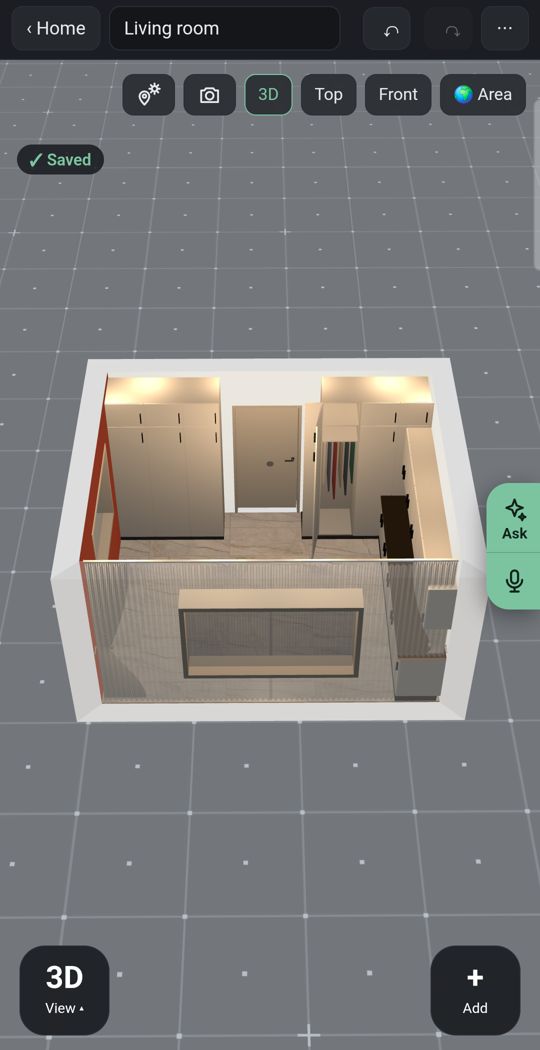
After sunset
Winter evenings start early here, with the sun down at 16:05 on the shortest day; plan ceiling lights, lamps and LED strips and see where each room needs them.
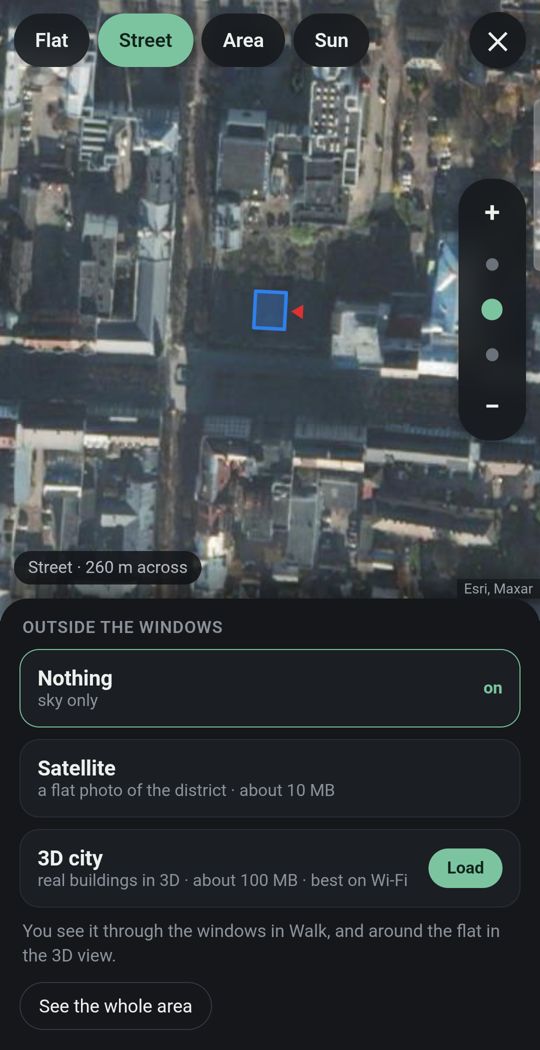
Your road around you
Whether it is a Roath terrace or a flat by the Bay, the address brings up the nearby street and buildings in 3D, where the map has them.
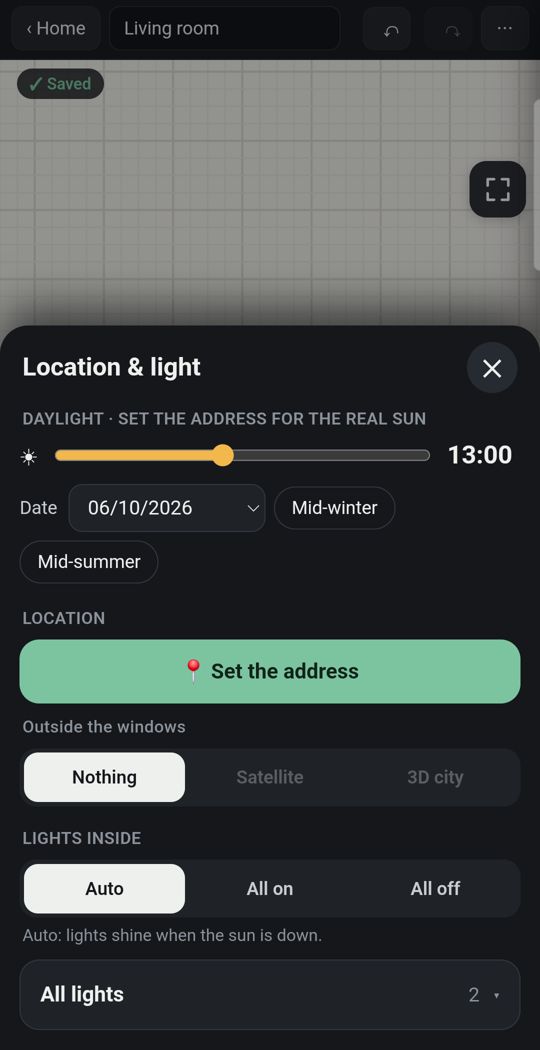
Your address, your light
It is your address's own sun, any day, any hour, and the app keeps count of how long each room is in direct sun.
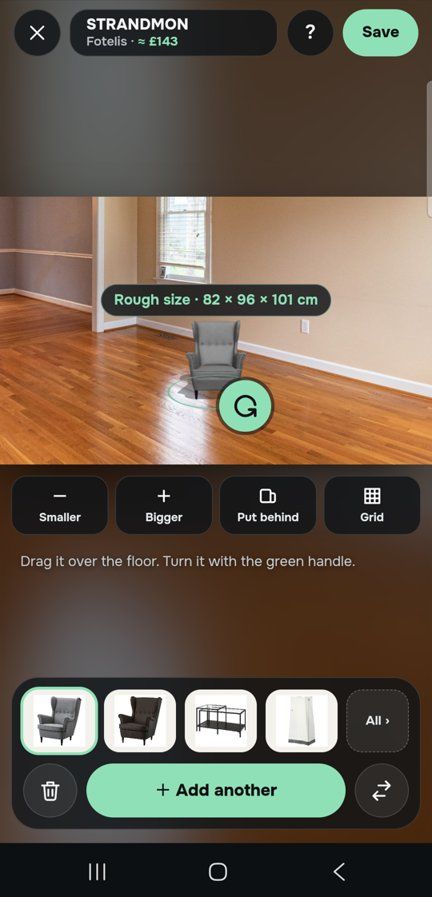
Real size, your room
One piece at a time, a sofa for instance, can be stood at its true size on your own floor, seen through the live camera or in a room photo.
Room by room detail
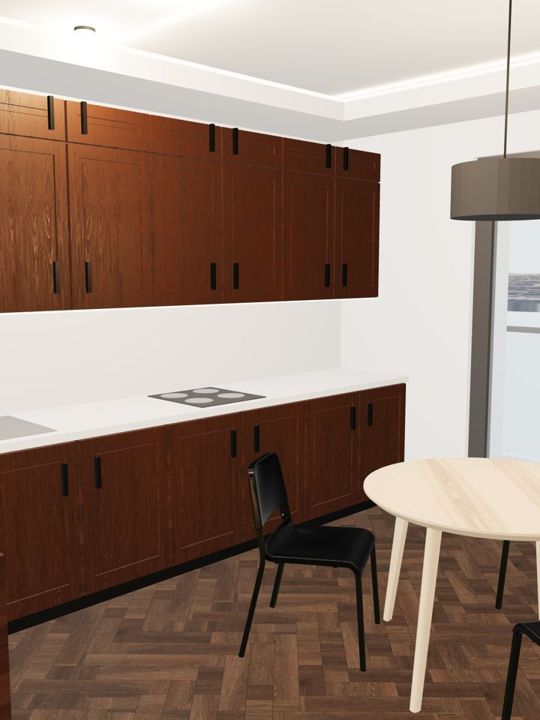
A kitchen is built from its units, a wardrobe from its parts, a bathroom piece by piece, and every window and door has its own type.
Thumb first
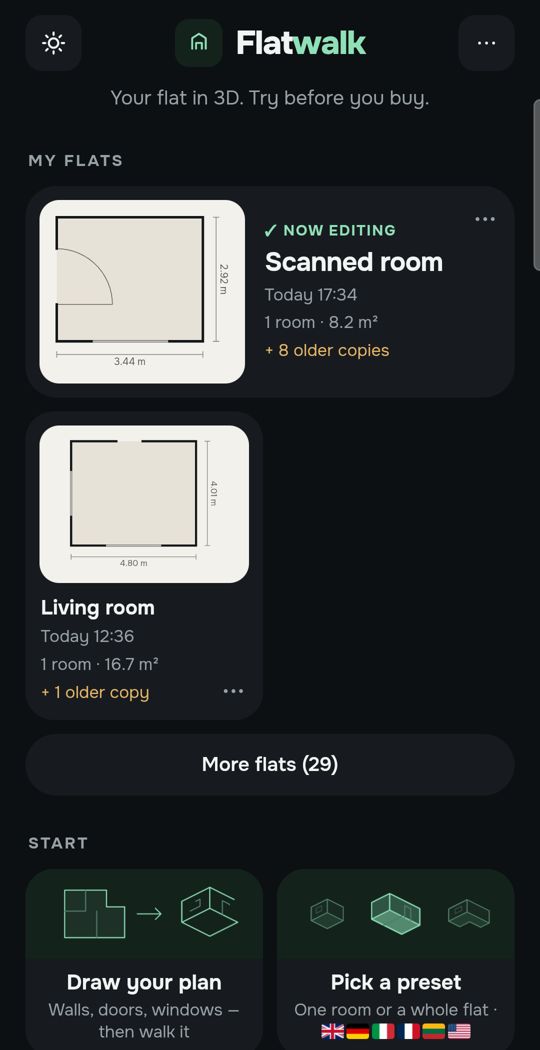
Built for the phone: drag the time of day with a thumb and watch sunlight cross the floor.
Swipe for more. Every picture is the app itself.
One flat, free
Flatwalk is free for the one home most people are planning. Draw it, see the sun at its address, add lights and furniture, walk around it and try each AI tool once, all without a card or a trial clock; you would only need a membership for more flats or more AI.
Questions people ask
What is the sun path in Cardiff? Through the winter months the arc is short and low, from the southeast round to the southwest, topping out at about 15° at midday on 21 December. In summer it stretches from the northeast to the northwest and tops out at about 62° on 21 June. Its rising and setting points are close to due east and due west near 21 March and 23 September.
What time is sunrise and sunset in Cardiff in December? Sunrise at 8:15 and sunset at 16:05 GMT on 21 December 2026 make 7h 50m of daylight. Darkness comes earliest in mid-December, with sunsets at about 16:03, but mornings stay darkest until the end of December, when sunrise is about 8:18.
Where does the sun rise and set in Cardiff? Southeast and southwest in midwinter: on the shortest day the sun comes up at about 128° and goes down at about 232°. Northeast and northwest in midsummer: about 49° and about 311° on the longest day.
Which way should my flat face in Cardiff? In Cardiff's terraced streets, start with which way your side of the street faces: the best is somewhere between south-east and south-west, which gets the most sun over the year and most of all in winter, though west suits evenings in and east early risers. Then check what stands opposite. On the shortest day, a five-storey block across a 20 m street would leave the three lowest floors with no sun at noon.
How high is the sun in Cardiff in winter? Not high: roughly 15° at noon on 21 December, and under about 20° from mid-November to mid-January. That makes the rule simple: if the top of the building or terrace across the street sits more than 15° above your window, as you see it from your chair, the midday sun is gone.
Flatwalk puts the real sun for your address into a 3D plan of your flat, by date and hour, free for one flat. It is coming soon to Google Play; join the waiting list at flatwalk.app.
Join the waiting list