Short answer. On Southampton's shortest day, 21 December, the sun rises at 8:05 GMT out of the southeast (128°), climbs to only about 16° at midday and sets at 16:01 GMT in the southwest (232°), giving 7h 56m of daylight. On 21 June it is up at 4:51 BST in the northeast (50°), about 62° high at midday and down at 21:23 BST in the northwest (310°): a day of 16h 32m. A window facing south over open water or open ground can have the sun all through a December day; one facing north has none.
See the sun at your own window
Southampton's sun by month
Every figure in the table belongs to the city centre of Southampton (50.91° N, 1.40° W) and the 15th of the month, through 2026, with times by the clock. Directions read clockwise from true north, so 90° is east, 180° south and 270° west, and from Shirley to Portswood the times would change by around a minute.
| Date | Sunrise | Sunset | Daylight | Sun height at noon | Sunrise direction | Sunset direction |
|---|---|---|---|---|---|---|
| 15 January (GMT) | 8:01 | 16:28 | 8h 26m | 18° | ESE, 124° | WSW, 237° |
| 15 February (GMT) | 7:18 | 17:21 | 10h 04m | 27° | ESE, 109° | WSW, 251° |
| 15 March (GMT) | 6:19 | 18:10 | 11h 51m | 37° | E, 92° | W, 268° |
| 15 April (BST) | 6:11 | 20:01 | 13h 50m | 49° | ENE, 73° | WNW, 287° |
| 15 May (BST) | 5:16 | 20:48 | 15h 32m | 58° | ENE, 58° | WNW, 302° |
| 15 June (BST) | 4:51 | 21:21 | 16h 30m | 62° | NE, 50° | NW, 310° |
| 15 July (BST) | 5:08 | 21:13 | 16h 05m | 61° | NE, 53° | NW, 307° |
| 15 August (BST) | 5:52 | 20:26 | 14h 34m | 53° | ENE, 66° | WNW, 293° |
| 15 September (BST) | 6:40 | 19:19 | 12h 39m | 42° | E, 84° | W, 275° |
| 15 October (BST) | 7:28 | 18:13 | 10h 45m | 30° | ESE, 103° | WSW, 257° |
| 15 November (GMT) | 7:21 | 16:18 | 8h 57m | 21° | ESE, 119° | WSW, 241° |
| 15 December (GMT) | 8:01 | 15:59 | 7h 58m | 16° | SE, 127° | SW, 232° |
In 2026 the clocks go forward on 29 March and back on 25 October, which is why April to October are given in BST. Solar noon, the moment the sun is due south and highest, comes at 12:03 GMT on 21 December and 13:07 BST on 21 June, and the "Sun height at noon" column records the sun's height then, above a flat horizon.
Southampton compared with London
Set beside central London, Southampton sits 0.6° further south in latitude and 1.3° further west in longitude, and both shifts show up in the numbers. Being further south gives it 6 minutes more daylight on 21 December and 7 minutes less on 21 June, while being further west makes its clock times run later: in winter sunrise is 2 minutes and sunset 8 minutes later than London's, and in June sunrise is 8 minutes and sunset 2 minutes later. At midday on the shortest day the sun here is 15.7° up, 0.6° above London's 15.1°. The general pattern: south gives longer winter days and shorter summer ones, and west shifts sunrise and sunset later by the clock, about 4 minutes for each degree.
Hours of sun on each side of a flat in Southampton
The table gives, direction by direction, the most direct sun a window could get if the horizon were flat and nothing blocked it: an upper limit under open sky. Whatever really stands in front of the window, buildings, trees or the balcony above, brings these figures down, and in winter, with the sun low, it brings them down most.
| Window faces | 21 December | 21 March | 21 June |
|---|---|---|---|
| North | None | 15 min | 7 h 15 min |
| North-east | 35 min | 3 h 35 min | 6 h 35 min |
| East | 4 h | 6 h 05 min | 8 h 15 min |
| South-east | 7 h 20 min | 8 h 35 min | 10 h |
| South | 7 h 55 min | 12 h | 9 h 15 min |
| South-west | 7 h 20 min | 8 h 40 min | 10 h |
| West | 4 h | 6 h 05 min | 8 h 15 min |
| North-west | 35 min | 3 h 35 min | 6 h 35 min |
The pattern:
- The winter split. In December a real day of sun only comes to windows facing the southern half of the compass: south has all 7 h 55 min of daylight, east and west about 4 hours, north none.
- The summer twist. With the June sun rising and setting well to the north, the diagonal walls win: south-east and south-west get 10 h, south 9 h 15 min, and a north window even collects 7 h 15 min, early and late in the day.
- The spring balance. North is left with just 15 min around 21 March, when the sun comes up almost due east and goes down almost due west.
Think of these as the top of the range. Whatever stands along your street comes off them in the sun tool, one building at a time.
What it means for flats in Southampton
- A rebuilt centre, a walled old town. Much of the city centre was rebuilt after the wartime bombing, so many central flats are in post-war blocks, often with more space around them than an old street of terraces, while stretches of the medieval walls still stand nearby. Many waterside flats look out over the Test or the Itchen, and open water in front means no building opposite at all; where that water lies to the south-east, south or south-west, little stands in the way of the low winter sun. In the Victorian terraces of Shirley and Portswood the houses are lower, but the streets are narrower, so the terrace across the road still decides how much winter sun the ground floor gets.
- Best directions. A main window or balcony somewhere between south-east and south-west is what to look for if winter sun matters; east gets the morning, west the evening, and a north outlook steady light with direct sun only on summer mornings and evenings.
- Low floors in winter. Even a moderate street shades the lower floors in December. A five-storey block 15 m (49 ft) tall on one side of a 20 m (66 ft) street, measured wall to wall, casts a midday shadow about 53 m (175 ft) long, 2.7 times that width, because the noon sun on 21 December is only about 16° up. Across that street the facade is in midday shade up to about 9.4 m, which, with the ground floor as storey 1 and 3 m to a storey, means storeys 1 to 3 go without midday sun on the shortest day and storey 4 is the first to get it. The March picture is kinder: at about 18 m on 21 March, the shadow no longer reaches across the street, and every floor has midday sun.
- Overhangs. Summer is when the balcony above shades a south window most: at about 62° the June sun comes in steeply, whereas the 16° winter sun gets in beneath it, and a west balcony keeps the June sun right up to sunset, after 21:00.
- Gardens behind the house. On 21 December the midday shadow of a house 6 m to the eaves stretches about 21 m, pointing away from the sun to the north, so a garden on the north side can spend midwinter in it, while a south facing garden stays clear unless its neighbours to the south are tall. Under the high June sun the same house casts only about 3 m.
Check your own window in Southampton in 3 steps
Flatwalk's free tool for this, Sun at your window, adds up the direct sun on one real window, allowing for the buildings, trees and ground nearby, whether that window looks over the Itchen or onto a terraced street in Portswood. Southampton's building outlines are on its map; its heights are not measured, though, because measured heights so far stop at London, Manchester, Cardiff, Edinburgh and Glasgow, so they are estimated here and the tool makes that clear. Heights that look wrong on a block opposite, too tall or too low, can be changed with Something off?, and missing big trees put in.
- Locate your home. Satellite map first: after typing your address under "See the sun at your window", find your own roof among the others, then choose between A whole house and A flat and, for a flat, set Your floor.
- Place each window. Walls come labelled, "South wall · sun side" for example, so tap the one with your window in it, then tap where the window is or drag to draw it.
- Run the check. With Shortest day chosen for the December test, a tap on See my sun brings up your window's hours of direct sun, the 12 month bars and "What takes your sun"; turn on Typical weather to see how the usual clouds change the hours.
What it cannot tell you
- Calculated, not recorded. These are predictions built from maps and the sun's position, which is not the same as a light meter reading at your window.
- Approximate heights in Southampton. The measured-height cities are London, Manchester, Cardiff, Edinburgh and Glasgow; here heights are estimated from the map, which makes it worth checking any building that matters to you.
- Out of date in places. The map lags behind the city: blocks finished since the map data, and trees planted or cut down since about 2017 to 2019, stay missing or wrong until you fix them through Something off?, where heights can be corrected and buildings and trees added.
- Cloud is averaged. Expect a typical year, not a forecast: Typical weather uses monthly averages over 2005 to 2023, which at a single window may be about 10 to 15% off.
- Built around windows. Ask it about a window and it answers; ask about a lawn, a terrace floor or a roof for solar panels and it cannot.
- No survey. If light ever becomes a legal matter with a neighbour, you need a right to light survey; this is not one, nor a legal or certified report of any kind.
- What it leaves out: the shape of your own roof, tinted glass and window frames, and it trusts map outlines that can be a metre off the real wall.
Try it free: your Southampton address, your floor, your window
What Flatwalk does that older planners skip
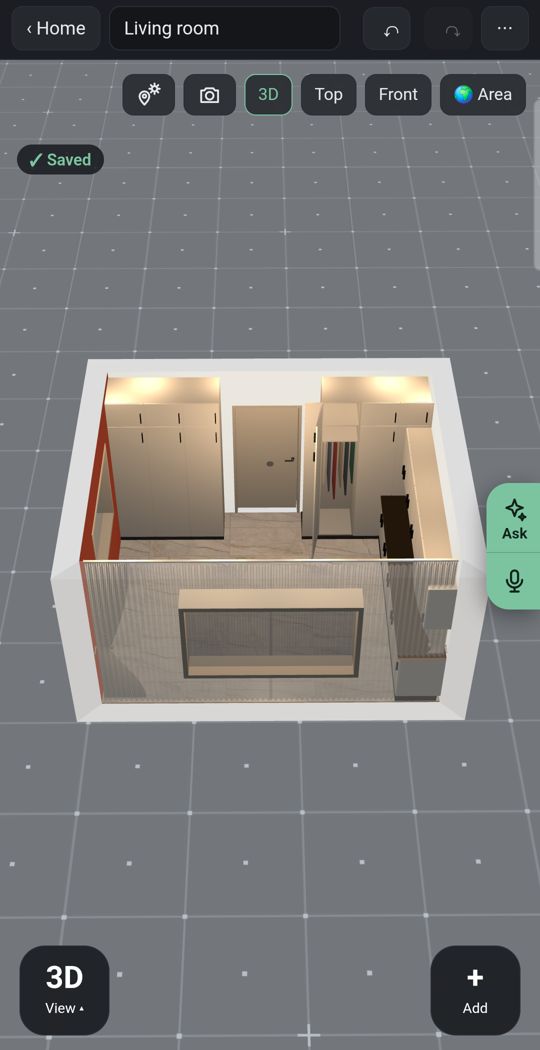
Lighting for the evening
Ceiling lights, lamps and LED strips can all be placed and switched on, to show where the rooms need light after the 16:01 sunset in December.
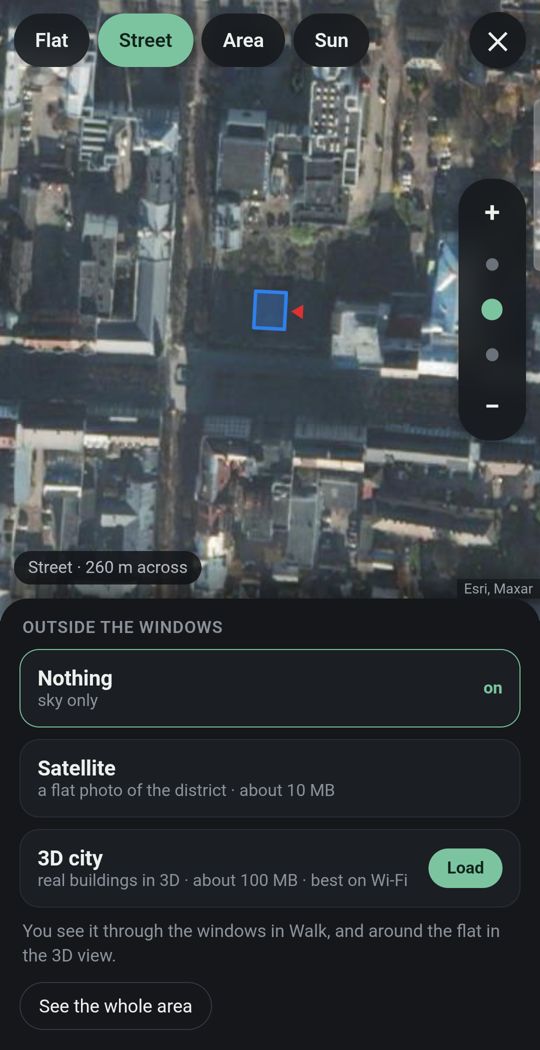
Your part of town in 3D
Old town, waterside or terraced street: give the address and the buildings and street around you appear in 3D wherever the map holds them.
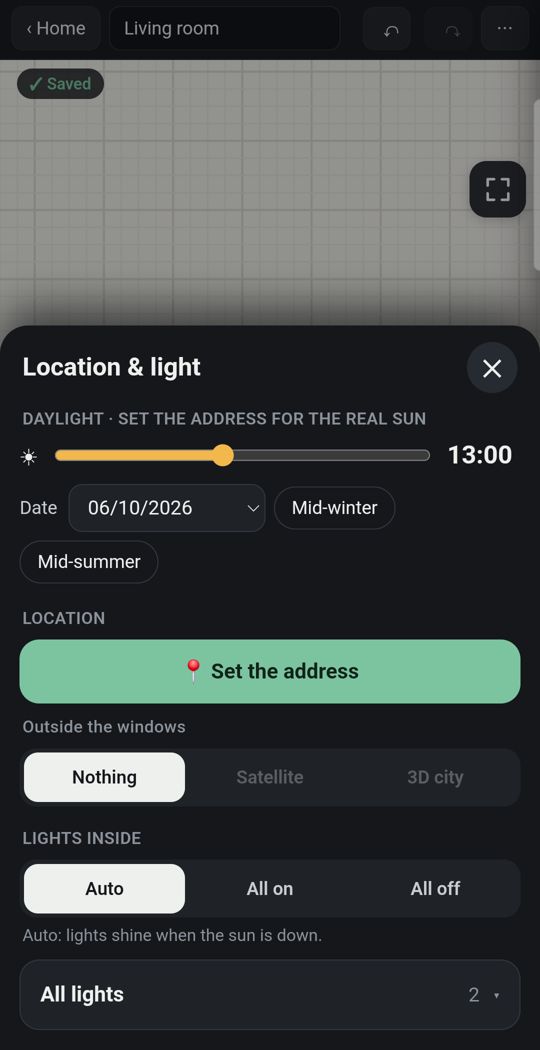
Real sun, your address
Move through the dates and hours and the sunlight follows your real address, room by room, with how long each one gets direct sun.
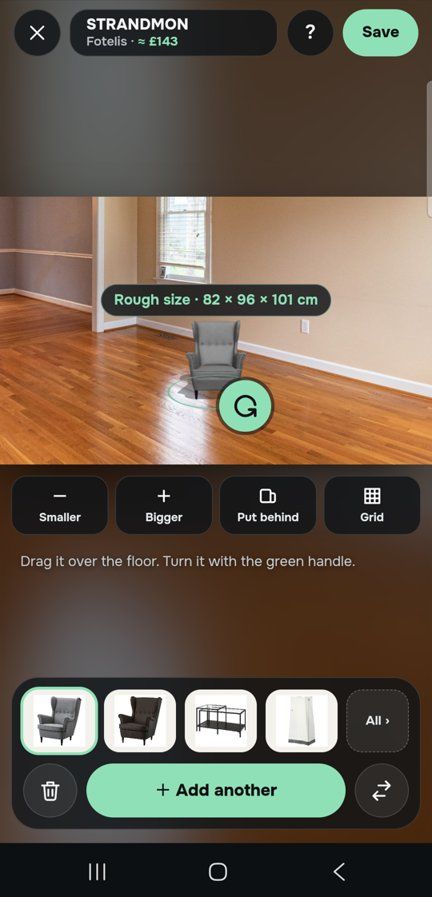
Before you buy the sofa
Your own floor, a sofa at its true size: open the live camera, or a photo of the room, and place it.
Every part
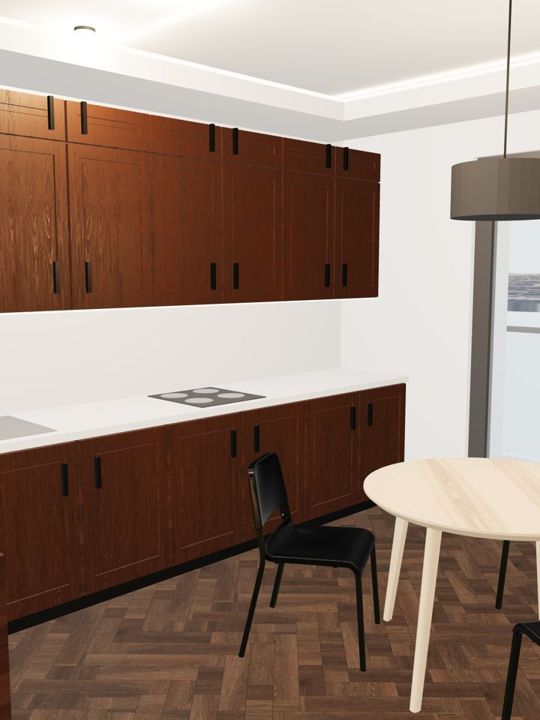
No placeholder boxes: kitchens, wardrobes and bathrooms are built piece by piece, and every window and door has a type.
Made for one hand
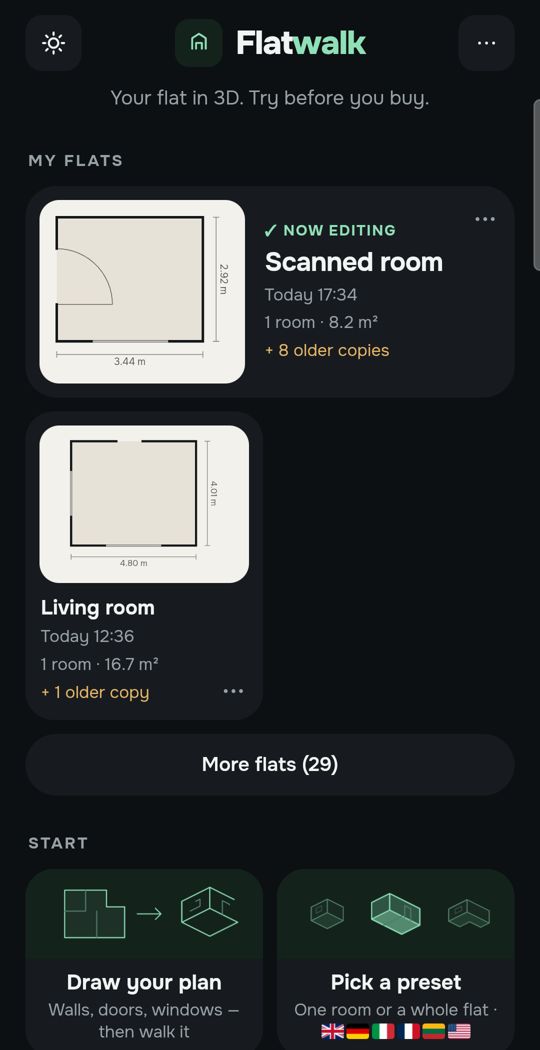
A single finger moves the hour on the phone; the light follows it through the rooms.
Swipe for more. Every picture is the app itself.
One flat, free
Flatwalk charges nothing for planning one home: no trial clock, no card. Drawing it, its sun, lights, furniture and walking through it come included, with one free try of each AI tool, and membership exists only for those who want more flats or more AI.
Questions people ask
What is the sun path in Southampton? Picture a low arc in winter and a high one in summer. The December arc starts in the southeast, peaks at about 16° over the south at midday on 21 December and ends in the southwest; the June arc starts in the northeast, peaks at about 62° on 21 June and ends in the northwest. In between, at about 21 March and 23 September, it comes up and goes down within a few degrees of due east and due west.
What time is sunrise and sunset in Southampton in December? Daylight on 21 December 2026 lasts 7h 56m, from an 8:05 sunrise to a 16:01 sunset, GMT. Mid-December has the earliest sunsets, around 15:59, and the end of December the latest sunrises, around 8:08.
Where does the sun rise and set in Southampton? Round from the southeast and southwest in December to the northeast and northwest in June: on the shortest day, sunrise is at about 128° and sunset at about 232°, and on the longest, about 50° and about 310°.
Which way should my flat face in Southampton? Southampton flats facing anywhere from south-east round to south-west do best, through the year and above all in winter. If you are home in the evenings pick west; if you get up early, east. And size up the far side of the street: if a five-storey block stands across a 20 m street, it shades the lower three floors at midday on the shortest day.
How high is the sun in Southampton in winter? Southampton's midday sun is roughly 16° up on 21 December and stays below about 21° from mid-November to mid-January, so anything opposite that rises more than 16° above your window, seen from where you sit, hides it.
Flatwalk puts the real sun for your address into a 3D plan of your flat, by date and hour, free for one flat. It is coming soon to Google Play; join the waiting list at flatwalk.app.
Join the waiting list