Short answer. Shadow length = height ÷ tan(sun's height). When the sun is 45° up, a shadow is as long as the thing that casts it; at 15° it is almost four times as long; at 60° a little over half. So the same 10 m building throws a midday shadow of about 37 m in London in December and about 5 m in June. To see what a real building opposite does to your own window, hour by hour and month by month, use a sun tool that knows the street.
Try it free: type your address, add the building opposite, see the hours of sun you keep
The shadow length formula
On flat, level ground:
shadow length = height ÷ tan(sun altitude)
The sun's altitude is its height above the horizon in degrees. You can get it for any place and time from a sun path calculator, or work out the midday value yourself: 90 minus your latitude, plus about 23.4° in late June, 0 in late March and September, minus about 23.4° in late December.
Multiply the height of the object by this factor to get its shadow:
| Sun height | Shadow is this many times the height |
|---|---|
| 5° | 11.4 |
| 10° | 5.7 |
| 15° | 3.7 |
| 20° | 2.7 |
| 25° | 2.1 |
| 30° | 1.7 |
| 40° | 1.2 |
| 45° | 1.0 |
| 50° | 0.84 |
| 60° | 0.58 |
| 70° | 0.36 |
| 80° | 0.18 |
A 2 m fence with the sun at 20°: 2 × 2.7 = a shadow about 5.5 m long.
Which way it points. A shadow points straight away from the sun. At solar noon in the northern hemisphere the sun is due south, so the shadow points due north. On a December morning in London the sun is in the southeast, so shadows point northwest.
Worked table: the shadow of a 10 m building
A 10 m object is roughly a three-storey building or a big tree. Worked out with the standard sun formulas, flat ground, nothing else in the way. "Midday" is solar noon; "9 am / 3 pm" is three hours either side of it (solar time; with summer time the clock reads an hour later).
| City | 21 Dec, midday | 21 Dec, 9 am / 3 pm | 21 Mar, midday | 21 Mar, 9 am / 3 pm | 21 Jun, midday | 21 Jun, 9 am / 3 pm |
|---|---|---|---|---|---|---|
| Los Angeles (34° N) | About 16 m | About 30 m | About 7 m | About 14 m | About 2 m | About 8.5 m |
| New York (40.7° N) | About 21 m | About 42 m | About 8.5 m | About 16 m | About 3 m | About 9 m |
| Toronto (43.7° N) | About 24 m | About 50 m | About 9.5 m | About 17 m | About 3.5 m | About 9 m |
| London (51.5° N) | About 37 m | About 110 m | About 12.5 m | About 20 m | About 5.5 m | About 10 m |
| Edinburgh (56° N) | About 53 m | About 300 m | About 15 m | About 23 m | About 6.5 m | About 10.5 m |
For any other height, scale it: a 5 m house in New York at midday on 21 December throws about 10 m; a 30 m tower about 62 m.
Three things the table shows:
- Winter is what counts. In Edinburgh in December, at 9 am the sun is barely 2° up and a three-storey building's shadow runs for hundreds of metres. In practice the whole street is in shade.
- Summer shadows are short at midday but long again in the morning and evening, when the sun is low in the east and west.
- Spring and autumn are in between. On 21 March and 23 September the numbers are almost the same.
Slopes, width and real streets
The formula assumes flat ground and a thin object like a pole. Real life adds:
- Slopes. On ground rising away from the object, the shadow is shorter; on ground falling away, longer.
- Width. A long terrace or a wide block casts a wide shadow, so as the sun moves across the sky it stays behind the block for longer than it would behind a single tree.
- Trees. A leafy tree lets some light through, and much more in winter when it is bare. An evergreen lets little through all year.
What the building opposite does to your window
The shadow question most people really have is: will the building across the street put my window in shade? Turn the formula around:
- Take the height of the building above your window: its height minus the height of your window above the ground.
- Divide it by the distance from your window to the building.
- The angle whose tangent is that number is the angle from your window up to the top of the building. Whenever the sun is lower than that angle, and behind the building, your window is in its shadow.
An example in London. Your window is 4.5 m above the street (first floor, in UK terms). Due south of it stands a 15 m block, 20 m away. It rises 10.5 m above your window; 10.5 ÷ 20 = 0.525, which is an angle of about 28°. The midday sun in London only climbs above 28° from about 23 February to 18 October. For four months of the year, the window gets no midday sun.
| Building due south, 10.5 m taller than your window | Midday sun clears it in London | Midday sun clears it in New York |
|---|---|---|
| 20 m away (an angle of about 28°) | About 23 Feb to 18 Oct | About 14 Jan to 27 Nov |
| 30 m away (an angle of about 19°) | About 26 Jan to 15 Nov | All year |
Moving the building 10 m further away gives the London window almost two more months of midday sun. That is why the distance on the planning drawings matters as much as the height. In the morning and afternoon the sun comes from the side, so a building that is narrow or set off to one side lets some sun past; that part is hard to do by hand, and it is what the tool below works out.
More on this: will a new building next door block my sun? and which floor gets the most sun.
Check the shadows on your own window, step by step
Flatwalk's free tool, Sun at your window, works out the shadows of the buildings, trees and hills around your address and counts the hours of direct sun left on each window.
- Type your address under "See the sun at your window" and find your building on the satellite map. The one under the pin is green; tap another if it is wrong.
- Choose A whole house or A flat and set your floor and the storey height.
- Put your window on the wall. Each outside wall has a tag, such as "South wall · sun side". Tap the wall, then tap where the window is, or drag to draw it.
- Tap See my sun. You get the hours of direct sun today, the first and last sun, and "x% of the glass in sun" at each moment. Drag the hour to watch the shadows move; tap Shortest for December.
- Read "What takes your sun". It names each blocker, such as a building to the south or a tree to the east, with the months and hours it takes.
- Test the building opposite. Tap Something off? to fix the height of any building or tree, or Add a building: tap its corners where it stands (or will stand) and set its height in metres. After "Recalculating", a badge shows the change, such as "-1 h 05 today" or "No change today".
- Copy link to keep the view, with your added buildings, or send it to a neighbour.
Try it free: see whose shadow falls on your window
What it cannot tell you
- Modelled, not measured. The hours are worked out from maps and the sun's position, not from a light meter at your window.
- Where the data is best. Building heights are measured in London, Manchester, Cardiff, Edinburgh, Glasgow, Berlin, Munich, Hamburg, Warsaw, Kraków, Wrocław, New York City, Chicago, Toronto, Vancouver and Montreal. Elsewhere heights are estimated, and the tool says so; outside the areas it covers in the UK, Germany, Poland, Lithuania, the US and Canada it is slower and treats the ground as flat.
- New buildings and trees. Buildings finished after the map data, and trees planted or cut since about 2017 to 2019, are missing or wrong until you fix them. Young street trees under about 3 m are missing.
- Windows only. It does not measure a shadow on a lawn, a terrace floor or a roof for solar panels.
- Not a legal or certified report. It is not a right-to-light survey.
- Small things it ignores: window frames, glass tint and your own roof shape. Map outlines can be a metre off the real wall.
What Flatwalk does that older planners skip
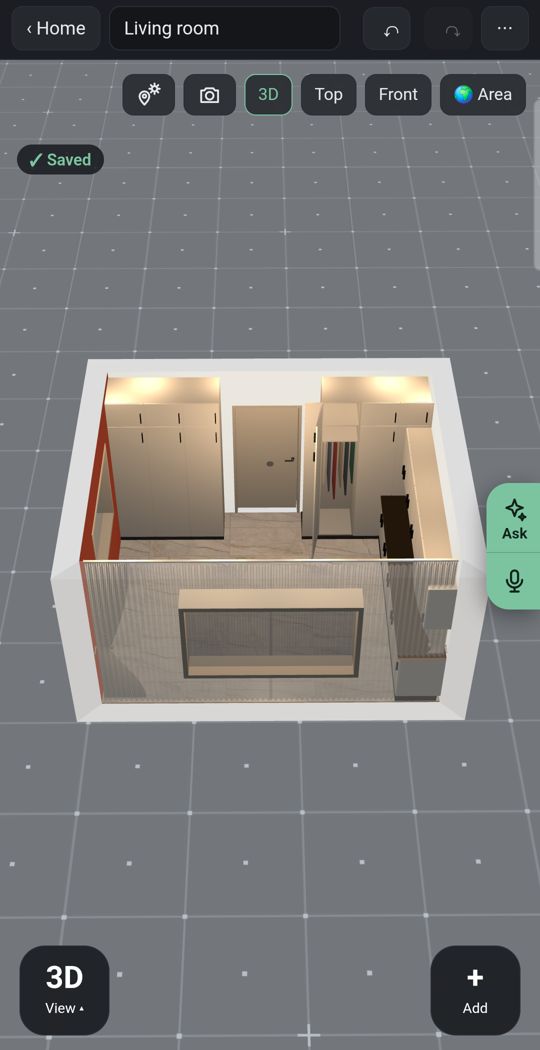
Lights
Add ceiling lights, lamps and LED strips and see where you need them after the sun goes down.
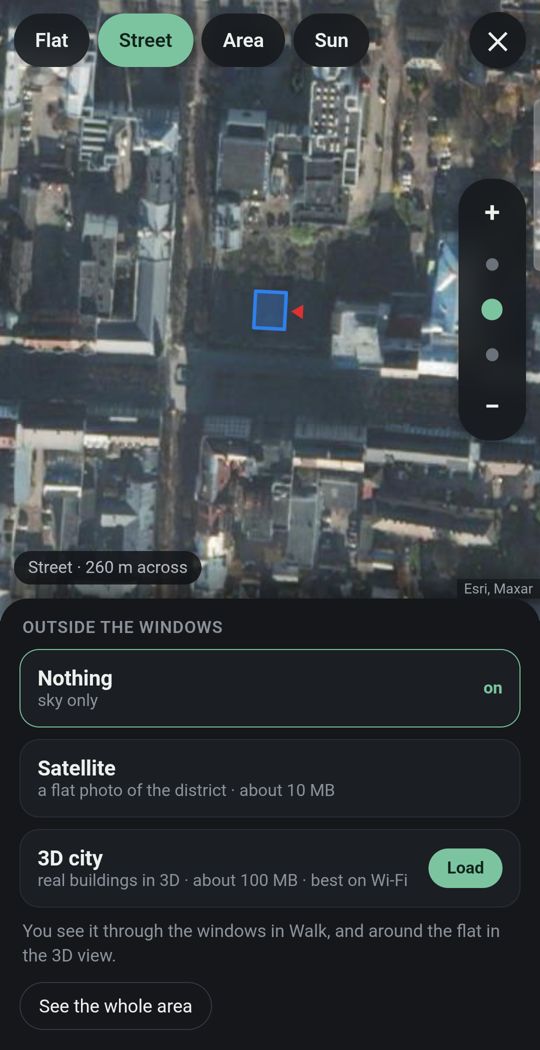
Your flat in its city
Enter your address and the street and buildings around you appear in 3D, wherever the map has them.
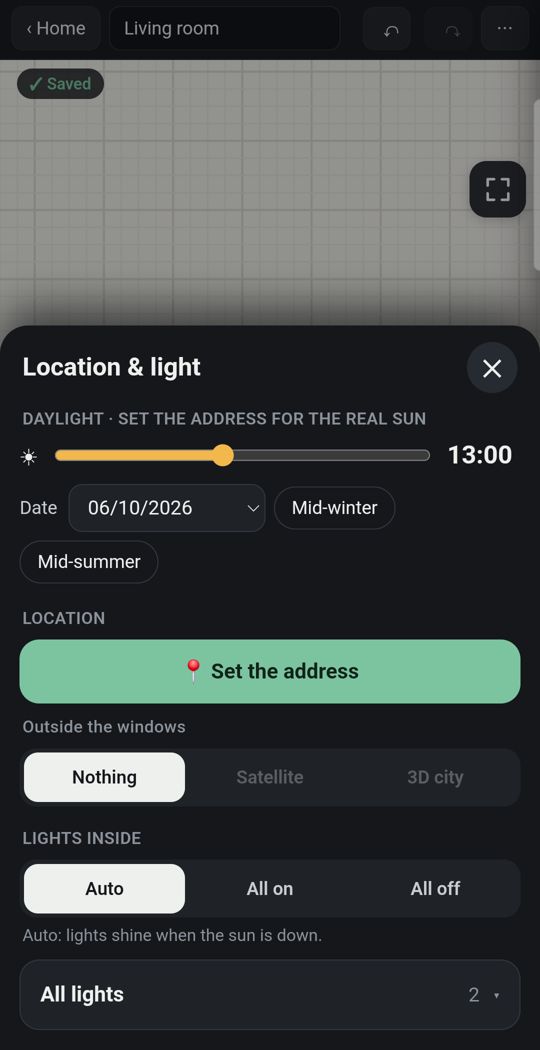
Sun for your address
Real sunlight by date and hour, and how long each room gets direct sun.
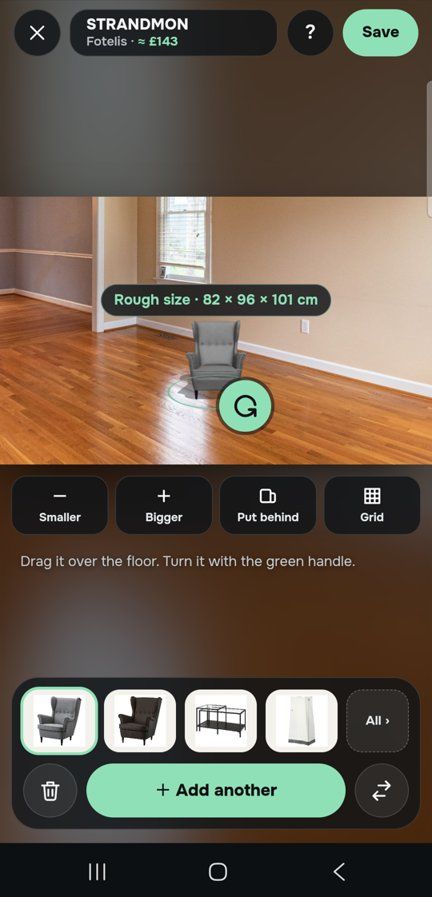
One piece, in your own room
Through the live camera or in a photo of the room, stand a sofa on your own floor at its true size.
Detail
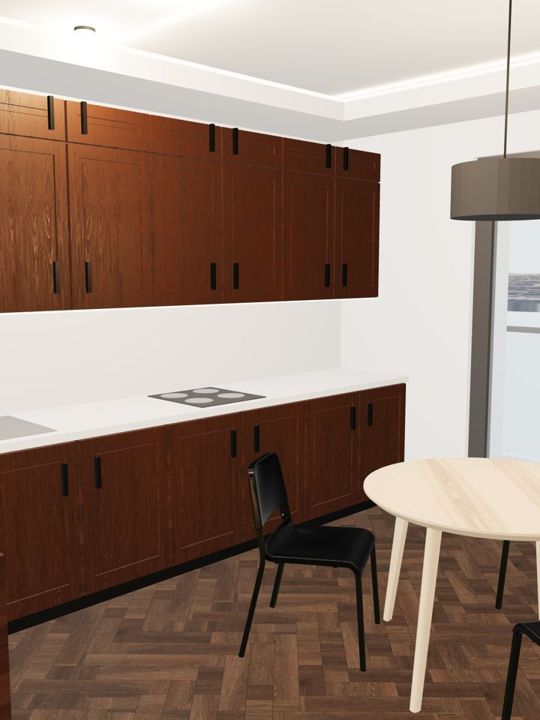
Window and door types, kitchens, wardrobes and bathrooms built piece by piece.
Made for a thumb
Slide the hour with one finger and watch the light move through the rooms.
Swipe for more. Every picture is the app itself.
One flat, free
Most people plan one home. For that, Flatwalk costs nothing: no time-limited trial and no card needed. Drawing the flat, the sun for its address, lights, furniture and walking through it are all part of it, and each AI tool comes with one free try. A membership is for people who want more flats or more AI.
Questions people ask
How do you calculate the length of a shadow? Divide the height of the object by the tangent of the sun's height above the horizon. With the sun at 30°, a 10 m building casts a shadow about 17 m long on flat ground.
How long is a shadow at noon? It depends on the date and your latitude. In London at solar noon a 10 m building casts about 37 m in late December, 12.5 m in late March and 5.5 m in late June. In New York, about 21 m, 8.5 m and 3 m.
When is the shadow the same length as the object? When the sun is 45° above the horizon. In London the midday sun only gets that high from about early April to early September; the rest of the year every shadow is longer than the thing that casts it.
Will the building opposite shade my window? Work out the angle from your window to its top (height above your window divided by the distance, then the angle with that tangent). Whenever the sun is lower than that, and behind the building, you are in its shadow. A sun tool with the real buildings gives the hours.
Does a shadow calculator count trees and hills? A plain calculator does not: it only knows the sun. Flatwalk's sun tool counts the buildings, trees and hills it has on its maps, and lets you add or fix any that are wrong.
Flatwalk puts the real sun for your address into a 3D plan of your flat, by date and hour, free for one flat. It is coming soon to Google Play; join the waiting list at flatwalk.app.
Join the waiting list