Short answer. In the northern hemisphere a south facing house or garden gets the most sun over the year, and above all in winter, when you want it. In a cool climate (the UK, Canada, the northern US) that is a real plus: brighter rooms, some free winter warmth, a garden that gets sun from morning to evening. In a hot climate the south side is still easy to manage, because the summer sun is high and a short overhang shades it; there the side to worry about is west. First check what "south facing" means on the listing (the front, the back or the garden), then check what stands to the south, because a tall neighbour or a row of trees can take that winter sun.
Try it free: type the address, put a window on each wall, see the hours of sun on each side
What "south facing" means on a listing
It is not always the same side of the house:
- "South facing house" in the US usually means the front of the house faces south. Then the backyard faces north.
- "South facing garden" in the UK means the garden lies to the south of the house: stand at the back door and you look south. Then the front of the house faces north.
- "South facing flat" or "condo" usually means the main windows or the balcony face south.
What matters for your daily life is which way the living room windows and the outdoor space face. Ask, or check on a map, before you get excited. More on gardens: which way does my garden face?
South of the equator it is the other way round: in Australia, New Zealand or South Africa the sunny side is north, and "north facing" is the selling point.
How many hours of sun each side gets
The most hours of direct sun a wall can get with a flat horizon and nothing in the way, worked out with the standard sun formulas. Neighbours and trees take a share, most of all in winter.
| City | Wall faces | 21 December | 21 March | 21 June |
|---|---|---|---|---|
| Phoenix (33° N) | South | About 9 h 45 min | About 12 h | About 6 h 30 min |
| East or west | About 4 h 55 min | About 6 h | About 7 h 10 min | |
| North | None | None | About 7 h 45 min | |
| New York (41° N) | South | About 9 h 05 min | About 12 h | About 8 h |
| East or west | About 4 h 35 min | About 6 h | About 7 h 30 min | |
| North | None | None | About 6 h 55 min | |
| Seattle (48° N) | South | About 8 h 15 min | About 12 h | About 8 h 55 min |
| East or west | About 4 h 10 min | About 6 h | About 7 h 55 min | |
| North | None | None | About 6 h 50 min | |
| London (51.5° N) | South | About 7 h 35 min | About 12 h | About 9 h 20 min |
| East or west | About 3 h 50 min | About 6 h | About 8 h 15 min | |
| North | None | None | About 7 h 10 min |
Two things stand out. In winter only the south side gets a full day of sun; north gets none. And in Phoenix in June the south wall gets fewer hours than the north wall, because the summer sun there rises and sets far to the north and stands almost overhead at midday.
Why the south side is easy to shade in summer
The summer sun on a south wall comes in steeply from high above; the winter sun comes in low. A simple roof overhang uses that. Take an overhang 0.6 m (2 ft) deep over a south window, at midday:
| City | 21 June: shade below the overhang | 21 December: shade below the overhang |
|---|---|---|
| Phoenix | About 3.4 m (the whole window) | About 0.4 m (the top of the window) |
| New York | About 1.9 m | About 0.3 m |
| London | About 1.1 m | About 0.15 m |
So the overhang keeps the summer sun out and lets the winter sun in. The same overhang over a west window at 4 pm in June shades only about 0.45 m in all three cities, because the afternoon sun comes in low from the side. That is why a west wall is the hard one to keep cool.
The U.S. Department of Energy's passive solar guide puts it this way: windows for winter sun should face within 30 degrees of true south and not be shaded from 9 a.m. to 3 p.m. in winter, with overhangs or trees to shade them in summer. In warmer climates it suggests north facing windows along with generously shaded south facing ones.
Pros and cons by climate
Cool and cold climates (the UK, Ireland, Canada, the northern US, northern Europe)
- Pros: the most sun in winter, when daylight is short; brighter living rooms; some free warmth through the glass; a south garden dries out and warms up earlier in spring.
- Cons: summer glare and heat in a glassy south room (shade it); furniture and floors can fade. A south facing front in the US means a north facing backyard.
Hot climates (the US Southwest, Texas, Florida, Australia's north)
- Pros: south (north in Australia) is the easiest side to shade, so with overhangs it gives light without much heat; winter sun is welcome even there.
- Cons: without shading it adds heat for much of the year. The big heat comes from west windows in the afternoon, so a house with its large glass to the west suffers more than one facing south.
Mixed climates (much of the US, central Europe): south with good overhangs is usually the best of both, as long as nothing blocks the low winter sun.
North, east and west compared
- North facing: steady, even light without direct sun for most of the year; cool in summer; dim and cold in winter. Good for artists' studios and bedrooms; a north garden gets sun at its far end in summer. See which way does my garden face for the house's own shadow.
- East facing: morning sun for breakfast and bedrooms, cooler afternoons. Good in hot climates.
- West facing: afternoon and evening sun, when most people are home. Lovely for a garden or balcony after work; the hottest rooms on summer evenings.
- South facing: the most sun over the year and the only full day of winter sun; easy to shade in summer.
In-between directions take a little from each side: a southwest garden gets late-morning to evening sun.
How to check a listing before you buy
- Find which side the listing means. Front, back, garden or the main windows?
- Open the house on a map with north at the top. Switch to satellite. The side facing the bottom of the screen faces south. Check the floor plan too: many have a small compass arrow.
- Read the photos. Shadows point away from the sun. In a photo taken from the house, midday shadows that fall towards the camera mean the sun is beyond the garden: a south facing garden.
- Look south. What stands on the sunny side, how tall and how close? A house two storeys taller than your window and 12 m (40 ft) away takes the midday sun in a London December. Big trees count too, more in summer when they are in leaf. Our shadow calculator guide shows how far a shadow reaches.
- Think about winter. A viewing in May or June flatters every house. In December the sun is low and easy to block.
- Check it by address with the steps below, and then at a viewing.
Check the sun on a house by address, step by step
Flatwalk's free tool, Sun at your window, counts the hours of direct sun on each window you put on the house, with the buildings, trees and hills around it.
- Type the address under "See the sun at your window". Suggestions come up while you type.
- Find the house on the satellite map. The one under the pin is green; tap another if it is wrong. If it is missing, tap "It's not on the map, I'll draw it".
- Tap A whole house ("All floors are mine").
- Read the wall tags. Every outside wall has a tag that says its direction, and the sunny ones say "sun side", such as "South wall · sun side". That settles which way the house faces.
- Put a window on each side. Tap a wall, then tap where the window is, or drag to draw it (wide and low for a patio door). Each one shows its exact direction, such as "Faces south-west, 224°".
- Tap See my sun. Read the hours of direct sun, the first and last sun and the 12 month bars ("Hours a day, by month"). Tap Shortest for December and Longest for June.
- Read the Sun score. It compares a window's year of sun with the same window facing due south with nothing in front (= 100). A "south facing" window with a low score is being blocked.
- See what takes your sun. "What takes your sun" names the blockers, such as a building to the south or a tree to the east, with the months and hours. Turn on Typical weather for the hours with the usual clouds.
- Copy link to keep it or send it to your partner or agent.
Try it free: see how much sun each side of the house gets
What it cannot tell you
- Windows only. It measures sun at the windows you draw, not across a lawn, on a deck floor or on a roof for solar panels.
- Modelled, not measured. The hours are worked out from maps and the sun's position, not from a light meter.
- Where the data is best. Building heights are measured in New York City, Chicago, Toronto, Vancouver, Montreal, London, Manchester, Cardiff, Edinburgh, Glasgow, Berlin, Munich, Hamburg, Warsaw, Kraków and Wrocław. Elsewhere heights are estimated, and the tool says so; outside the areas it covers in the US (New York State, California, Illinois), Canada (Ontario, British Columbia, Quebec), the UK, Germany, Poland and Lithuania it is slower and treats the ground as flat.
- New buildings and trees. Buildings finished after the map data, and trees planted or cut since about 2017 to 2019, are missing or wrong until you fix them with Something off?
- Weather. Typical weather is a monthly average from 2005 to 2023, not a forecast, and can be about 10 to 15% off for a window.
- Not a certified report. It cannot stand in for a professional sunlight survey.
- Small things it ignores: window frames, glass tint and your own roof shape. Map outlines can be a metre off the real wall.
What Flatwalk does that older planners skip
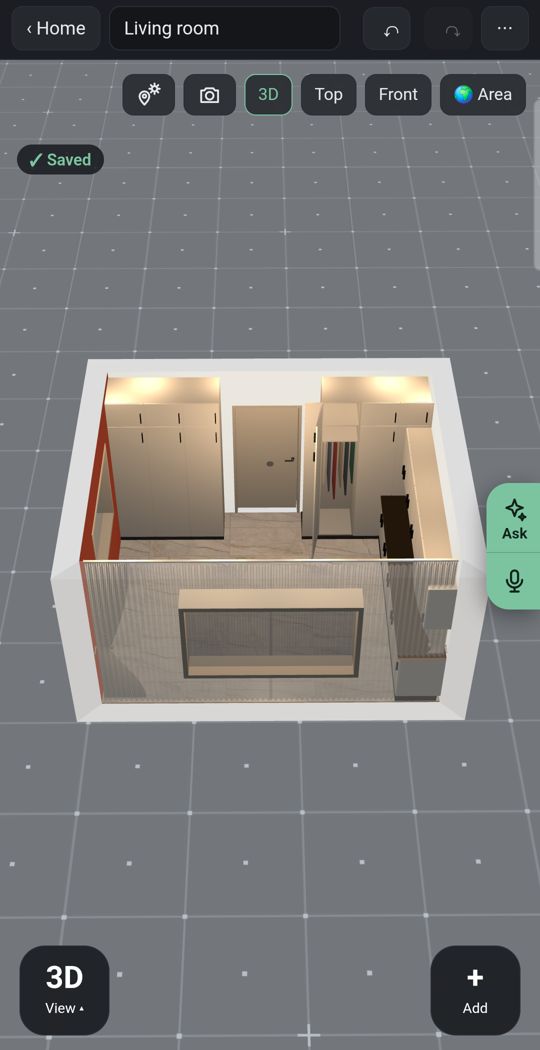
Lights
Add ceiling lights, lamps and LED strips and see where you need them after the sun goes down.
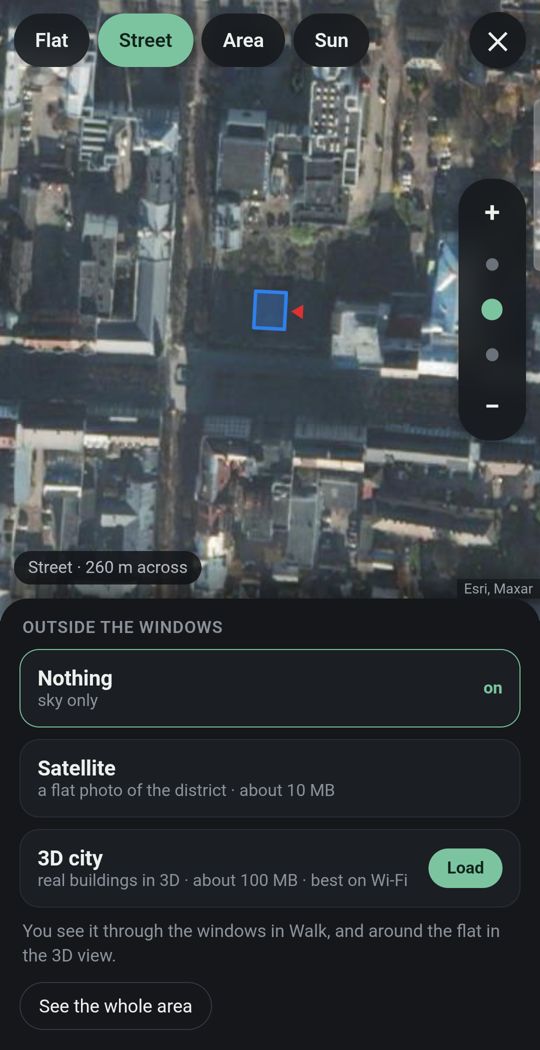
Your flat in its city
Enter your address and the street and buildings around you appear in 3D, wherever the map has them.
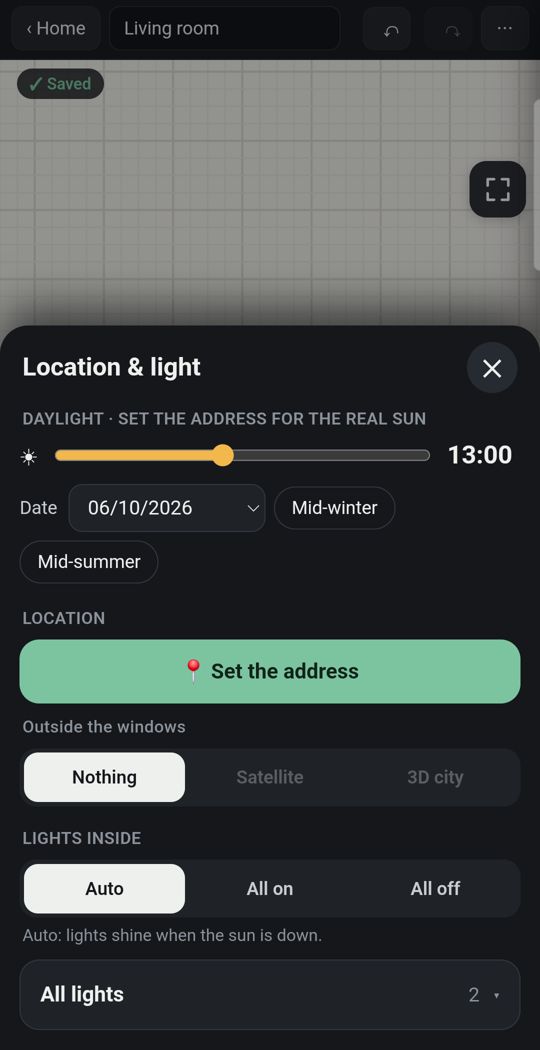
Sun for your address
Real sunlight by date and hour, and how long each room gets direct sun.
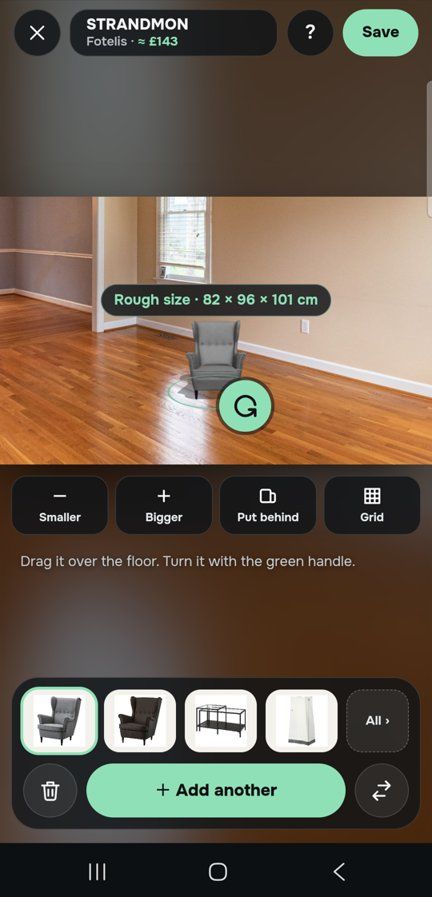
One piece, in your own room
Through the live camera or in a photo of the room, stand a sofa on your own floor at its true size.
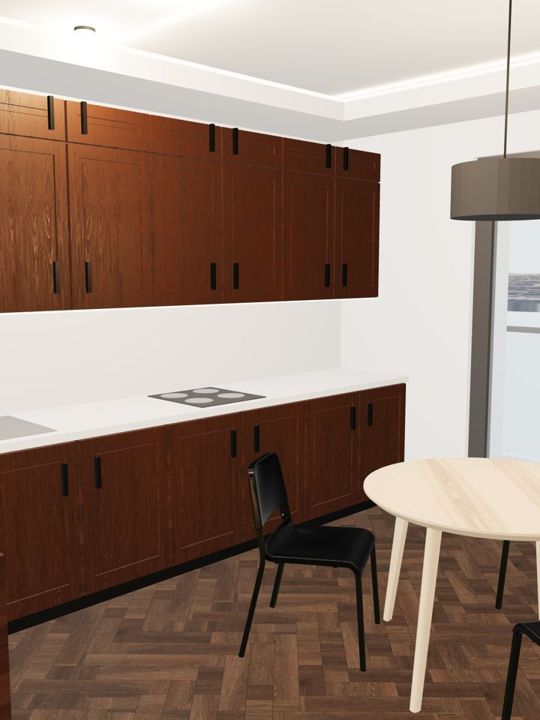
Detail
Window and door types, kitchens, wardrobes and bathrooms built piece by piece.
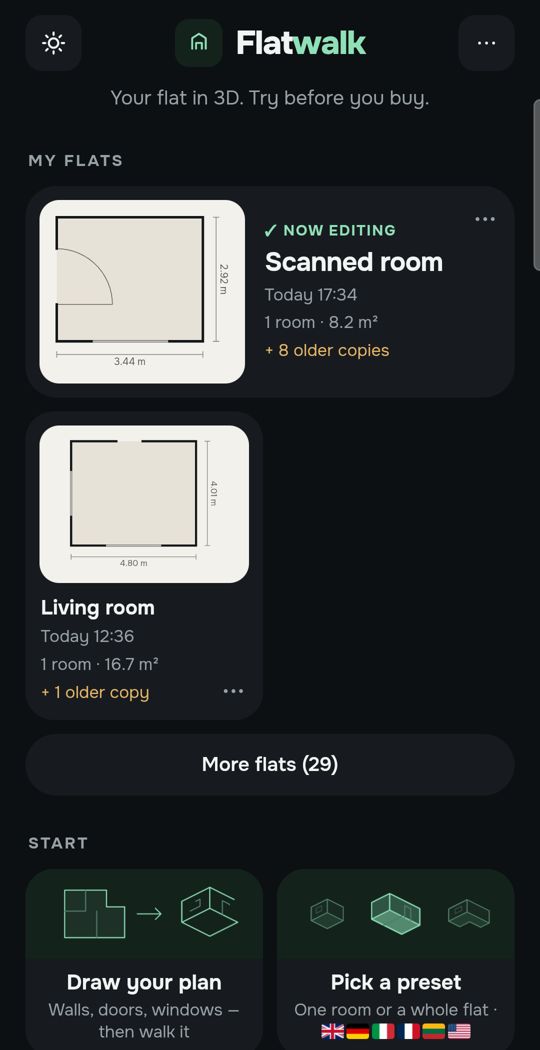
Made for a thumb
Slide the hour with one finger and watch the light move through the rooms.
Swipe for more. Every picture is the app itself.
One flat, free
Most people plan one home. For that, Flatwalk costs nothing: no time-limited trial and no card needed. Drawing the flat, the sun for its address, lights, furniture and walking through it are all part of it, and each AI tool comes with one free try. A membership is for people who want more flats or more AI.
Questions people ask
Is a south facing house good? In the northern hemisphere, usually yes: the south side gets the most sun over the year and the only full day of winter sun, and its summer sun is easy to shade with an overhang. Check which side the listing means and that nothing tall stands to the south.
What does south facing house mean? Usually that the front of the house faces south, so the backyard faces north. In the UK, "south facing garden" means the back garden lies to the south of the house. Ask which side is meant.
What are the pros and cons of a south facing house? Pros: more winter sun, brighter rooms, some free warmth. Cons: summer heat and glare without shading, fading furniture, and in the US often a north facing backyard.
Is a south facing garden good? It is the sunniest kind in the UK, with sun most of the day all year. West facing gardens get the evenings, east facing the mornings, and north facing gardens are shady near the house in winter.
Which way should a house face in a hot climate? The Department of Energy's passive solar guide suggests north facing windows plus generously shaded south facing ones in warmer climates. Keep large glass away from the west, where the low afternoon sun is hard to shade.
Flatwalk puts the real sun for your address into a 3D plan of your home, by date and hour, free for one home. It is coming soon to Google Play; join the waiting list at flatwalk.app.
Join the waiting list