Short answer. Glasgow gets 6h 58m of daylight on 21 December, from an 08:45 sunrise to a 15:44 sunset (GMT), and the midday sun manages only about 11°. On 21 June the day lasts 17h 35m, from 04:31 to 22:06 BST, and the sun climbs as high as about 58°. The December sun hauls itself up in the southeast at about 133° and sinks in the southwest at about 227°; by June the bearings have swung right round, to about 43° in the northeast at dawn and about 317° in the northwest at dusk. When the sun is this low, it is often the tenement over the street that settles whether your window gets any.
See the sun at your own window
Sunrise, sunset and sun height in Glasgow, month by month
The figures are for George Square, on the 15th of each month in 2026, and each time is what your phone would show: GMT in the winter, BST between 29 March and 25 October. A sunrise at 133° means the sun comes up a little east of southeast, because bearings run clockwise from true north, with east at 90°, south at 180° and west at 270°.
| Date | Sunrise | Sunset | Daylight | Sun at noon (height) | Sunrise direction | Sunset direction |
|---|---|---|---|---|---|---|
| 15 Jan | 08:37 GMT | 16:15 GMT | 7h 38m | 13° | 128° (SE) | 232° (SW) |
| 15 Feb | 07:41 GMT | 17:21 GMT | 9h 39m | 22° | 112° (ESE) | 249° (WSW) |
| 15 Mar | 06:32 GMT | 18:20 GMT | 11h 47m | 32° | 93° (E) | 268° (W) |
| 15 Apr | 06:11 BST | 20:23 BST | 14h 11m | 44° | 71° (ENE) | 289° (WNW) |
| 15 May | 05:05 BST | 21:22 BST | 16h 17m | 53° | 53° (NE) | 307° (NW) |
| 15 Jun | 04:31 BST | 22:04 BST | 17h 32m | 57° | 43° (NE) | 317° (NW) |
| 15 Jul | 04:52 BST | 21:52 BST | 16h 59m | 56° | 48° (NE) | 312° (NW) |
| 15 Aug | 05:48 BST | 20:53 BST | 15h 04m | 48° | 63° (ENE) | 297° (WNW) |
| 15 Sep | 06:48 BST | 19:34 BST | 12h 46m | 37° | 83° (E) | 276° (W) |
| 15 Oct | 07:47 BST | 18:16 BST | 10h 28m | 26° | 104° (ESE) | 256° (WSW) |
| 15 Nov | 07:52 GMT | 16:09 GMT | 8h 16m | 16° | 123° (ESE) | 237° (WSW) |
| 15 Dec | 08:41 GMT | 15:42 GMT | 7h 01m | 11° | 133° (SE) | 227° (SW) |
Glasgow's key dates:
- 21 December: Glasgow's shortest day, 6h 58m long, opens at 08:45 and closes at 15:44, and the sun gets no higher than about 11°, at 12:15 GMT.
- 21 March: sunrise 06:16 and sunset 18:32 GMT, each near due east or due west, with a noon sun of around 35°.
- 21 June: light from 04:31 until 22:06, a 17h 35m day, and the sun at about 58° when it peaks at 13:18 BST.
Why are Glasgow's sunsets later than Edinburgh's? Glasgow is over 4° west of Greenwich, around a degree further west than Edinburgh, so it meets the sun due south later by the clock: about 12:15 GMT in winter, 13:18 BST in summer. Its sunrises and sunsets run a few minutes behind as well.
Hours of sun on each side of a building in Glasgow
What follows is the direct sun a wall might get on each date, by the direction it faces, if nothing at all stood in front of it. Glasgow is full of tenements and tall blocks, so most real windows get less; the sun tool takes the buildings and trees in front of yours into account.
| Wall faces | 21 December | 21 March | 21 June |
|---|---|---|---|
| North | none | 17m | 7h 51m |
| Northeast | 7m | 3h 29m | 7h 01m |
| East | 3h 29m | 6h 07m | 8h 47m |
| Southeast | 6h 51m | 8h 45m | 10h 33m |
| South | 6h 58m | 11h 57m | 9h 43m |
| Southwest | 6h 51m | 8h 46m | 10h 33m |
| West | 3h 29m | 6h 08m | 8h 47m |
| Northwest | 7m | 3h 30m | 7h 01m |
What those Glasgow hours mean:
- December is a south-facing month. A south wall can hold the sun from sunrise until sunset on 21 December, all 6h 58m of it, and an east or west wall about 3h 29m.
- The north side lives on summer ends of the day. Its whole June allowance, about 7h 51m, arrives either early in the morning or in the evening, with nothing at midday, and from late September to about 20 March a north-facing room in a tenement gets no direct sun.
- Diagonal walls take June. Facing southeast or southwest, a wall gets the midday sun plus one end of the long day: 10h 33m on 21 June.
What that means for flats in Glasgow
- Best sides for sun. South, southeast or southwest for the winter. December's daylight is under 7 hours, of which an east or west window gets about half, under 3 and a half hours; in return, west windows get long summer evenings and east windows the early mornings.
- Front to the street, back to the court. Much of Glasgow lives in red and blond sandstone tenements built around shared back courts. Many of these flats have rooms on both sides, some looking onto the street and some over the back court, so a front that faces north often comes with a back that faces south. Ask which side the living room and bedrooms are on, because that can matter more than the address.
- Up the tenement. The low sun is soon hidden by a building across the street. With a five-storey block of about 15 m on the other side of a 20 m street, the midday shadow on 21 December stretches about 79 m and climbs to about 11.2 m on your wall: storeys one to four are in shade at noon, and the sun reaches only the fifth storey and higher. Wait until 21 March and the shadow has pulled back to about 22 m, a touch more than the street is wide, so only the very bottom of a ground-floor window is in it and every floor above has the midday sun. For more on tenement floors, see which floor gets the most sun.
- Tenements face to face. Where tenements of four storeys or so look at each other across a street, the low December sun can miss south-facing windows on the lower floors for most of the day, while the upper floors do better. The worked example above gives the idea, but your own street's numbers will differ.
- By the Clyde. A flat on the north bank of the Clyde, where the river runs roughly west to east, faces open water to its south, so nothing tall blocks the low winter sun on that side.
- Balconies, south or west. A south balcony catches the low winter sun if nothing tall is close in front, and in summer the balcony above keeps the high midday sun off the window below. Turned west, it is the place for a June evening, with sun until about 10:06 pm. The sides of a house are compared one by one in how much sun each side of a house gets.
- Back greens and gardens. Sun crosses a back garden that faces south from morning to evening. In December, though, a 7 m high house throws about 35 m of shadow at midday towards the north, so a back green on the north side of its tenement, which stands taller still, may get little winter sun, most of all near the building. Our which way does my garden face guide goes further.
- What could go up. If a gap site or a planning application sits to your south, count it as a possible loss of hours of winter sun in future. The checks are in will a new building block my sun.
Check your own window in Glasgow in 3 steps
The free Flatwalk tool for this is called Sun at your window, and it sets your building in 3D with the sun's path drawn over it. Glasgow gets the full treatment: measured building heights from the Scottish LiDAR laser survey, tree crowns, and the ground and hills.
- Look up your building. Whether it is a West End tenement or a flat by the Clyde, type the address into "See the sun at your window" and spot the building on the satellite map. Tell it A whole house or A flat; for a flat, add Your floor, which matters a lot in a tenement.
- Show it the window. Tags on each wall, such as "South wall · sun side", tell you which way it faces. Tap your wall, tap the window's position, and finish with See my sun.
- Go through your sun. Begin with Shortest day, the hardest test of the year, then check the 12 month bars. With Typical weather on, the hours allow for Glasgow's usual cloud, and What takes your sun tells you which building or tree is to blame.
Things it will not do for you:
- An answer from maps, not a reading. Nobody visits with a light meter; the tool combines map data with where the sun is and calculates the hours.
- Changes since the map was drawn. Has a block been finished since the map data, or a tree planted or felled since about 2017 to 2019? Then the model has it missing or wrong until you report it with Something off?
- A weather forecast. Typical weather is not one: it uses the average cloud for each month over 2005 to 2023, which can leave a window's hours about 10 to 15% off.
- Sun on anything but windows. It has nothing to say about sun on a garden lawn, a terrace floor or a roof you want solar panels on.
- A legal document. For a legal fight over light you would need a right to light survey; nothing here is certified or legal in that sense.
- Every small detail. It will not fuss over window frames, tinted glass or the shape of your own roof, and be aware that a map outline may land a metre off the real wall.
See the sun at your own window
What Flatwalk does that older planners skip
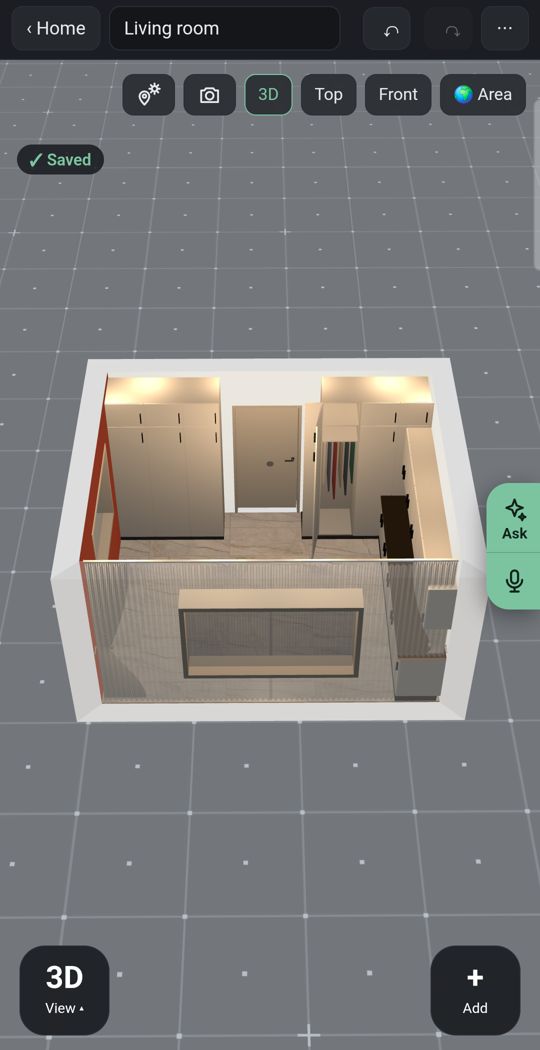
Lights you can place
Hang ceiling lights, stand lamps and run LED strips in the plan, then see after sunset which rooms still feel gloomy.
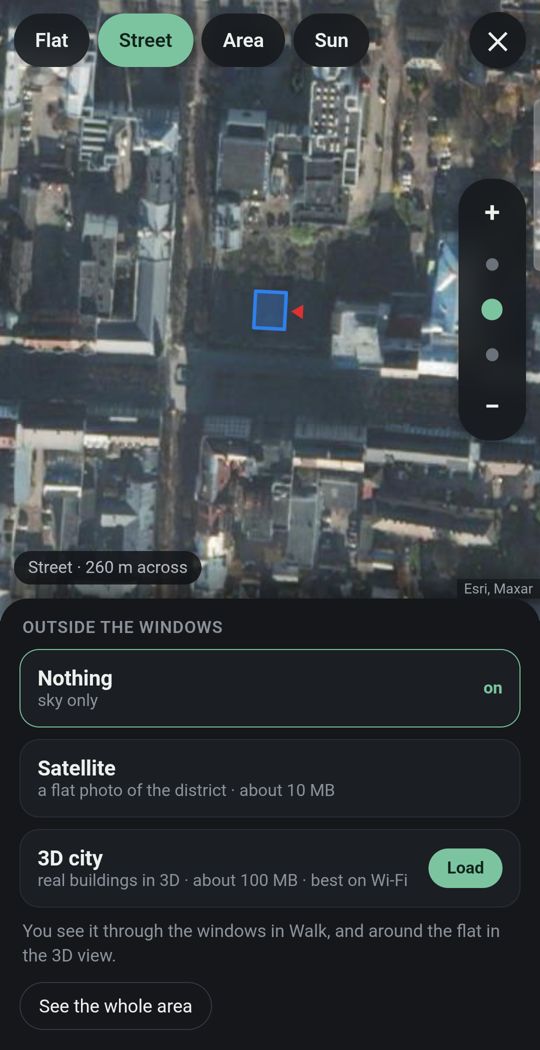
Your close and your street
Type the address and up go the tenements and the street around you in 3D, as far as the map has them.
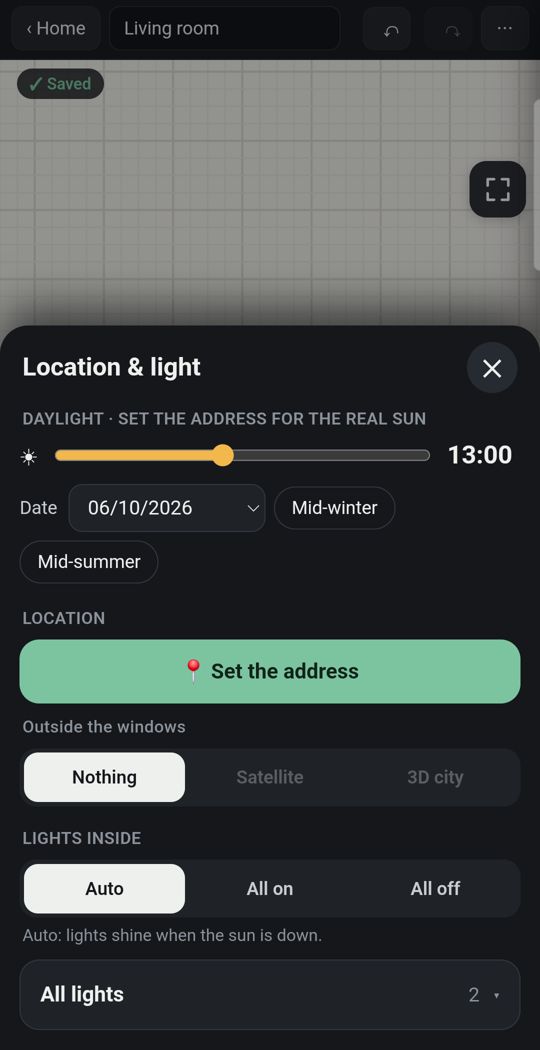
Sun hour by hour
Set the date and the time and the real sunlight lands on your flat, with a tally of each room's direct sun.
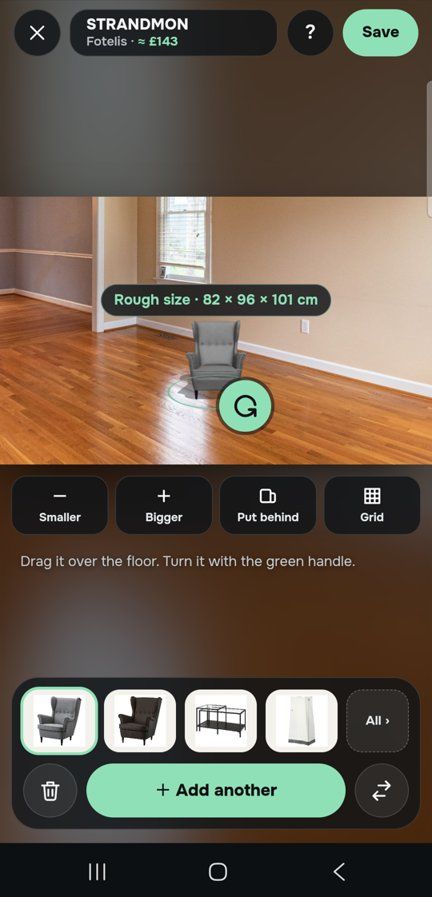
See it in your own room
Will the sofa fit the bay window? The live camera, or a photo you have taken of the room, puts it on your own floor at its true size so you can check.
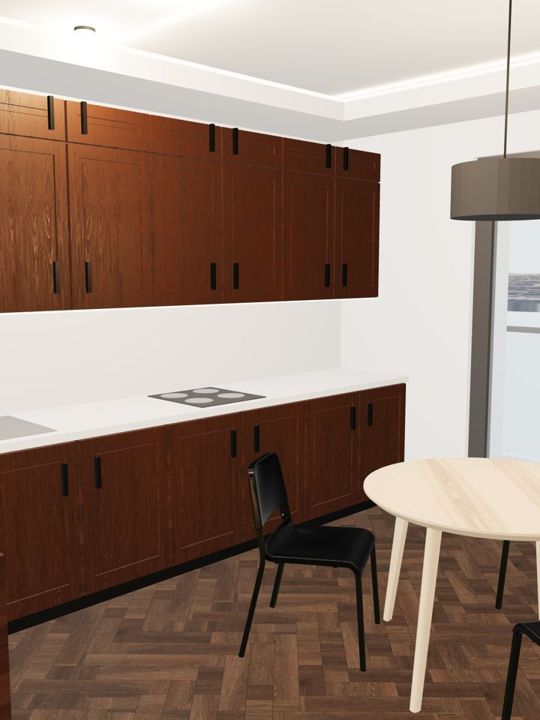
All the details
Set the type of every window and door, then fit kitchens, wardrobes and bathrooms one item at a time.
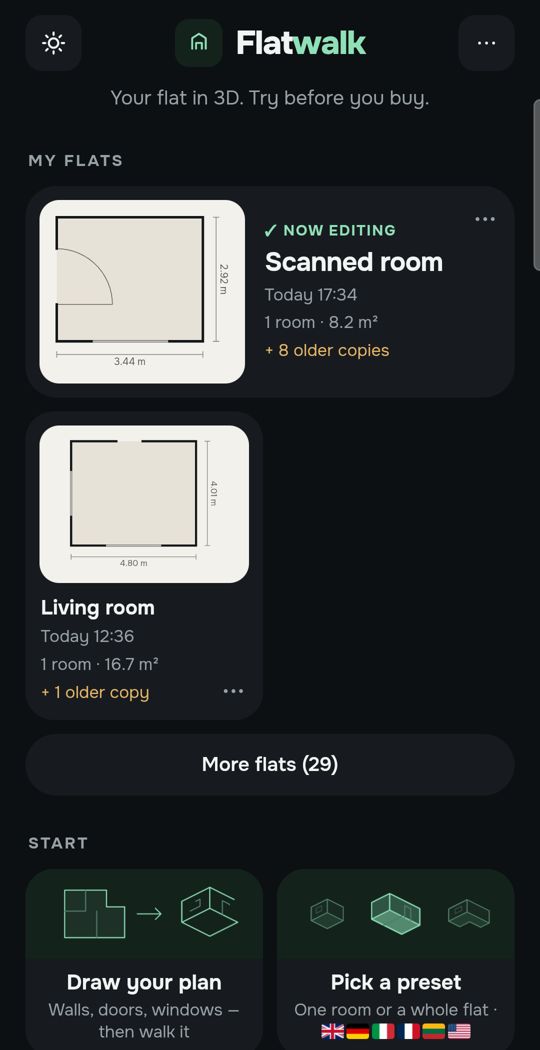
Thumb-sized
Run your finger along the hour slider and the light moves through the flat, one-handed on the phone.
Swipe for more. Every picture is the app itself.
One flat, free
One home is what most people plan, and for one home Flatwalk is free, with no trial to run out and no card on file. Nothing is held back for that one flat: you draw it, light it, furnish it, walk through it and see the sun at its address, and each AI tool gives you one free try. Beyond that, more flats or more AI come with a membership.
Questions people ask
What is the sun path in Glasgow? In winter the sun makes a low arc, coming up in the southeast, rising to about 11° at midday and going down in the southwest. Come summer, the arc runs from a northeast sunrise up to about 58° and round to a northwest sunset. Spring and autumn sit in between: in late March and late September the sun rises and sets close to due east and due west.
What time is sunset in Glasgow in December? At 15:44 GMT on 21 December, following an 08:45 sunrise, for 6h 58m of daylight. On 21 June the sun goes down at 22:06 BST after 17h 35m of daylight.
Where does the sun rise and set in Glasgow? Midwinter sunrise is at about 133° (southeast) and sunset at about 227° (southwest); midsummer sunrise is at about 43° (northeast) and sunset at about 317° (northwest).
Which way should my flat face in Glasgow? South, southeast or southwest for the winter sun, preferably higher up if a tenement stands across the street, and remember that the back court side may be the sunny one. Evening sun in summer comes in at west windows and morning sun at east ones, while a north window in a tenement sits without direct sun from late September to about 20 March.
How high is the sun in Glasgow in winter? Glasgow's winter sun peaks at only about 11°, at midday on 21 December, and in that light a five-storey building's shadow runs about 79 m.
Flatwalk puts the real sun for your address into a 3D plan of your flat, by date and hour, free for one flat. It is coming soon to Google Play; join the waiting list at flatwalk.app.
Join the waiting list